


Modern Methods Of Quarrying. Part 3
Description
This section is from "Scientific American Supplement". Also available from Amazon: Scientific American Reference Book.
Modern Methods Of Quarrying. Part 3
Another theory which is much the same in substance is then given, and after some general discussion of the theory of the action of the forces under the several systems, the paper continues:
The new form of hole is, therefore, almost identical in principle with the old Portland canister, except that it has the greater advantage of the V-shaped groove in the rock, which serves as a starting point for the break. It is also more economical than the Portland canister, in that it requires less drilling and the waste of stone is less. It is, therefore, not only more economical than any other system of blasting, but it is more certain, and in this respect it is vastly superior to any other blasting system, because stone is valuable, and anything which adds to the certainty of the break also adds to the profit of the quarryman.
It is doubtless true that, notwithstanding the greater area of pressure in the new form of hole, the break would not invariably follow the prescribed line but for the V-shaped groove which virtually starts it. A bolt, when strained, will break in the thread whether this be the smallest section or not, because the thread is the starting point for the break. A rod of glass is broken with a slight jar provided a groove has been filed in its surface. Numerous other instances might be cited to prove the value of the groove. Elasticity in rock is a pronounced feature, which varies to a greater or less extent; but it is always more or less present. A sandstone has recently been found which possesses the property of elasticity to such an extent that it may be bent like a thin piece of steel. When a blast is made in the new form of hole the stone is under high tension, and being elastic it will naturally pull apart on such lines of weakness as grooves, especially when they are made, as is usually the case in this system, in a direction at right angles with the lines of least resistance.
Horizontal holes are frequently put in and artificial beds made by "lofting." In such cases where the rock has a "rift" parallel with the bed, one hole about half way through is sufficient for a block about 15 ft. square, but in "liver" rock the holes must be drilled nearly through the block and the size of the block first reduced.
A more difficult application of the system, and one requiring greater care in its successful use, is where the block of stone is so situated that both ends are not free, one of them being solidly fixed in the quarry wall. A simple illustration of a case of this kind is a stone step on a stairway which leads up and along a wall, Fig. 11. Each step has one end fixed to the wall and the other free. Each step is also free on top, on the bottom and on the face, but fixed at the back. We now put one of the new form of holes in the corner at the junction of the step and the wall. The shape of the hole is as shown in Fig. 12.

FIG. 11
It is here seen that the grooves are at right angles with each other, and the block of stone is sheared by a break made opposite and parallel with the bench, as in the previous case, and an additional break made at right angles with the bench and at the fixed end of the block. Sometimes a corner break is made by putting in two of the regular V-shaped holes in the lines of the proposed break and without the use of the corner hole. A useful application of this system is in splitting up large masses of loose stone. For this purpose the V-shaped grooves are sometimes cut in four positions and breaks are made in four directions radiating from the center of the hole as shown in Fig. 12. In this way a block is divided into four rectangular pieces.
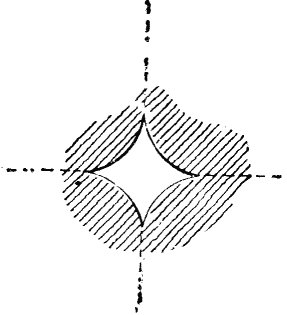
FIG. 12
Though the new system is especially adapted to the removal of heavy masses of rock, yet it has been applied with success in cases where several light beds overlie each other. In one such instance 10 sheets, measuring in all only 6 ft., were broken by a blast, but in cases of this kind the plug and feather process applies very well, and the new system, when used, must be in the hands of an expert, or the loss will be serious.
Referring again to our stone step, let us imagine a case where this stairway runs between two walls. We have here each step fixed at each end and free only on the top, the bottom, and one face. Let us assume that there is a back seam, that is, that the step is not fixed at the back. In a quarry, this seam, unless a natural one, should be made by a channeling machine. In order to throw this step put of place it must be cut off at both ends, and for this purpose the V-shaped holes are put in at right angles to the face. It is well, however, to put the first two holes next the back seam in a position where the grooves will converge at the back so as to form a sort of key, which serves a useful purpose in removing the block after the blast. In quarries where there are no horizontal beds a channeling machine should be used to free the block on all sides and to a suitable depth, and then the ledge may be "lofted" by holes placed horizontally.
Where "pressure" exists in quarries, the new system has certain limitations. After determining the line of "pressure" it is only practicable to use the system directly on the line of thrust, or at right angles to it. It is much better, however, to release the "pressure" from the ledge by channeling, after which a single end may be detached by a Knox blast. It is well to bear in mind that the holes should invariably be of small diameter. In no case should the diameter of a hole be over 1½ in. in any kind of rock. This being the case, the blocks of stone are delivered to the market with but little loss in measurement. It is a noticeable fact that stone quarried by the new system shows very little evidence of drill marks, for the faces are frequently as true as though cut with a machine.
A further gain is the safety of the system. The blasting is light and is confined entirely within the holes. No spalls or fragments are thrown from the bast.
The popular idea that the system is antagonistic to the channeling process is a mistaken one. There are, of course, some quarries which formerly used channeling machines without this system, but which now do a large part of the work by blasting. Instances, however, are rare where the system has replaced the channeler. The two go side by side, and an intelligent use of the new system in most quarries requires a channeling machine. There are those who may tell of stone that has been destroyed by a blast on the new system, but investigation usually shows that either the work was done by an inexperienced operator, or an effort was made to do too much.
A most interesting illustration of the value of this system, side by side with the channeler, is shown in the northern Ohio sandstone quarries. A great many channeling machines are in use there, working around the new form of holes, and when used together in an intelligent and careful manner, the stone is quarried more cheaply than by any other process that has yet been devised.
To a limited extent the system has been used in slate. The difficulty is that most of the slate quarries are in solid ledges, where no free faces or beds exist; but it has been used with success in a slate quarry at Cherryville, Pa., since 1888. Among notable blasts made by this system are the following: At the mica schist quarries, at Conshohocken, Pa., a hole 1½ in. in diameter was drilled in a block which was 27 ft. long, 15 ft. wide and 6 ft. thick. The blast broke the stone across the "rift," only 8 oz. of black powder being used. At the Portland, Conn., quarries a single blast was fired by electricity, 15 holes being drilled with 2 lb. of coarse No. C powder in each hole, and a rock was removed 110 ft. long, 20 ft. wide and 11 ft. thick, containing 24,200 cu. ft., or about 2,400 tons, the fracture being perfectly straight. This large mass of stone was moved out about 2 in. without injury to itself or the adjoining rock.
Another blast at Portland removed 3,300 tons a distance of 4 in. Seventeen holes were drilled, using 2 lb. of powder in each hole, the size of the block being 150 × 20 × 11 ft. In a Lisbon, O., quarry a block of sandstone 200 ft. long, 28 ft. wide and 15 ft. thick was moved about ½ in. by a blast. This block was also afterward cut up by this system in blocks 6 ft. square. A sandstone bowlder 70 ft. long, average width 50 ft., average thickness 13 ft., was embedded in the ground to a depth of about 7 ft. A single hole 8 ft. deep was charged with 20 oz. of powder and the rock was split in a straight line from end to end and entirely to the bottom. A ledge of sandstone open on its face and two ends, 110 × 13 × 8 ft., was moved by a blast about 3 in. without wasting a particle of rock, 8 holes being used, drilled by three men in just one day, and 15 oz. of powder being used in each hole. A sandstone ledge, open on the face and end only, 200 × 28 × 15 ft., containing 84,000 cu. ft. stone, was moved ½ in. by 25 holes, each containing 1 lb. of powder.
Continue to:


My Books

