


Modern Methods Of Quarrying
Description
This section is from "Scientific American Supplement". Also available from Amazon: Scientific American Reference Book.
Modern Methods Of Quarrying
Mr. Wm. L. Saunders, for many years the engineer of the Ingersoll Rock Drill Co., and hence thoroughly familiar with modern quarrying practice, read a paper before the last meeting of the American Society of Civil Engineers on the above subject, containing many interesting points, given in the Engineering News, from which we abstract as follows.
As a preliminary to describing the new Knox system of quarrying, which even yet is not universally known among quarrymen, Mr. Saunders gives the following in regard to older methods:
The Knox system is a recent invention; no mention was made of it in the tenth census, and no description has yet been given of it in any publications on quarrying. The first work done by this method was in 1885, and at the close of that year 2 quarries had adopted it. In 1886 it was used in 20 quarries; in 1887 in 44, in 1888 in upward of 100, and at the present time about 300 quarries have adopted it. Its purpose is to release dimension stone from its place in the bed, by so directing an explosive force that it is made to cleave the rock in a prescribed line without injury. The system is also used for breaking up detached blocks of stone into smaller sizes.
Quarrymen have, ever since the introduction of blasting, tried to direct the blast so as to save stock. Holes drilled by hand are seldom round. The shape of the bit and their regular rotation while drilling usually produce a hole of somewhat triangular section. It was observed, many years ago, that when a blast was fired in a hand-drilled hole the rock usually broke in three directions, radiating from the points of the triangle in the hole. This led quarrymen to look for a means by which the hole might be shaped in accordance with a prescribed direction of cleavage.
The oldest sandstone quarries in America are those at Portland, Conn. It was from these quarries that great quantities of brownstone were shipped for buildings in New York. The typical "brownstone front" is all built of Portland stone. As the Portland quarries were carried to great depths the thickness of bed increased, as it usually does in quarries. With beds from 10 to 20 ft. deep, all of solid and valuable brownstone, it became a matter of importance that some device should be applied which would shear the stone from its bed without loss of stock and without the necessity of making artificial beds at short distances. A system was adopted and used successfully for a number of years which comprised the drilling of deep holes from 10 to 12 in. in diameter, and charging them with explosives placed in a canister of peculiar shape. The drilling of this hole is so interesting as to warrant a passing notice. The system was similar to that followed with the old fashioned drop drill. The weight of the bit was the force which struck the blow, and this bit was simply raised or lowered by a crank turned by two men at the wheel.
The bit resembled a broad ax in shape, in that it was extremely broad, tapering to a sharp point, and convex along the edge.
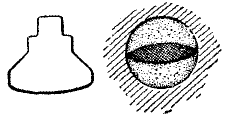
FIG. 1
Fig. 1 illustrates in section one of the Portland drills, and a drill hole with the canister containing the explosive in place. The canister was made of two curved pieces of sheet tin with soldered edges, cloth or paper being used at the ends. It was surrounded with sand or earth, so that the effect of the blast was practically the same as though the hole were drilled in the shape of the canister. In other words, the old Portland system was to drill a large, round hole, put in a canister, and then fill up a good part of the hole. Were it possible to drill the hole in the shape of the canister, it would obviously save a good deal of work which had to be undone. The Portland system was, therefore, an extravagant one, but the results accomplished were such as to fully warrant its use. Straight and true breaks were made, following the line of the longer axis of the canister section, as in Fig. 2.
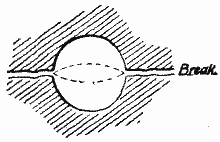
FIG. 2
It was found that with the old Portland canister two breaks might be made at right angles by a single blast, when using a canister shaped like a square prism. In some of the larger blasts, where blocks weighing in the neighborhood of 2,000 tons were sheared on the bed, two holes as deep as 20 ft. were drilled close together. The core between the holes was then clipped out and large canisters measuring 2 ft. across from edge to edge were used.
In regard to another of the older systems of blasting, known as Lewising, Mr. Saunders says:
A Lewis hole is made by drilling two or three holes close together and parallel with each other, the partitions between the holes being broken down by using what is known as a broach. Thus a wide hole or groove is formed in which powder is inserted, either by ramming it directly in the hole, or by puling it in a canister, shaped somewhat like the Lewis hole trench. A complex Lewis hole is the combination of 3 drill holes, while a compound Lewis hole contains 4 holes. Lewising is confined almost entirely to granite. In some cases a series of Lewis holes is put in along the bench at distances of 10 and 25 ft. apart, or even greater, each Lewis hole being situated equidistant from the face of the bench. The holes are blasted simultaneously by the electric battery.
After noting another system used to a limited extent, and not to be commended, viz., the use of inverted plugs and feathers (the plugs and feathers being inserted as a sort of tamping which the blast drives upward to split the rock), Mr. Saunders continues in substance as follows:
It is thus seen that the "state of the art" has been progressive, though it was imperfect. Mr. Sperr, in his reference to this subject, made in the report of the tenth census, says: "The influence of the shape of the drill hole upon the effects of the blast does not seem to be generally known, and a great waste of material necessarily follows." This was written but a few years before the introduction of the new system, and it is doubtless true that attention was thus widely directed to the conspicuous waste, due to a lack of knowledge of the influence of the shape of a drill hole on the effect of a blast. The system developed by Mr. Knox practically does all and more than was done by the old Portland system, and it does it at far less expense. It can best be described by illustrations.
Continue to:


My Books

