


New Bleaching Apparatus
Description
This section is from "Scientific American Supplement". Also available from Amazon: Scientific American Reference Book.
New Bleaching Apparatus
The apparatus forming the subject of this invention was designed by Francis A. Cloudman, Erwin B. Newcomb, and Frank H. Cloudman, of Cumberland Mills, Me., and comprises a series of tanks or chests, two or more in number, through which the material to be bleached is caused to pass, being transferred from one to the next of the series in order, while the bleaching agent is caused to pass through the series of chests in the reverse order, and thus acts first and at full strength upon the materials which have previously passed through all but the last one of the series of chests and have already been subjected to the bleaching agent of less strength.
For convenience, the chest in which the material is first introduced will be called the "first of the series" and the rest numbered in the order in which the material is passed from one to the other, and it will be understood that any desired number may be used, two, however, being sufficient to carry on the process.
The invention is shown embodied in an apparatus properly constructed for treating pulp used for the manufacture of paper, and for convenience the material to be bleached will be hereinafter referred to as the pulp, although it is obvious that similar apparatus might be used for bleaching other materials, although the apparatus might have to be modified to adapt it for conveying other materials of different nature than pulp from one bleaching chest to the other and for separating out the bleaching liquid and conveying it from one chest to the other in the reverse order to that in which the material passes from one chest to the next.
The pulp material with which the apparatus herein illustrated is intended to be used is retained in suspension in the bleaching liquid and flows readily through ducts or passages provided for it in the apparatus in which the pulp to be bleached and the bleaching liquid are introduced together at the bottom of each chest and flow upward therethrough, while at the top of each chest there are two conveyors, one for carrying the pulp from one chest to the next in order, while the other carries the bleaching liquid from one tank to the next in the reverse order, the said conveyors also acting to partially separate the pulp from the liquid in which it has been suspended during its upward passage through the chest.
Suitable agitators may be employed for thoroughly mixing the materials in the chest and in the apparatus shown the bleaching agent and material to be bleached pass through each chest in the same direction - namely from the bottom to the top - although they are carried from one chest to the next in the reverse order, the material to be bleached being primarily introduced into the chest at one end of the series, while the bleaching agent or solution is introduced primarily into the chest at the other end of the series.
Fig. 1 is a plan view of an apparatus for bleaching in accordance with this invention, comprising a series of four chests, and Fig. 2 is a vertical longitudinal section of a modified arrangement of two chests in line with one another, and with the conveyor for the material to be bleached and the passage through which said material passes from the top of one chest into the bottom of the next chest in the plane of section.
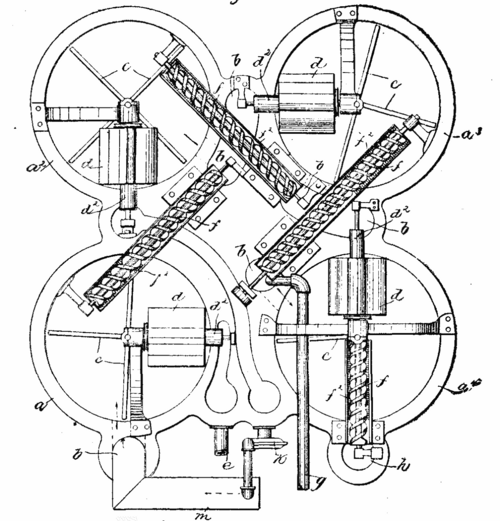
Fig. 1.
The chests, a a2 a3 a4, may be of any desired shape and dimensions and any desired number may be used. Each of said chests is provided with an inlet passage, b, opening into the same near its bottom, and through this passage the materials are introduced. The unbleached material, which may be paper pulp or material which is readily held in suspension in a liquid and is capable of flowing or being conveyed from one point to another in a semi-fluid condition, is introduced through the inlet passage, b, to the first chest, a, of the series, said pulp preferably having had as much as possible of the liquid in which it was previously suspended removed without, however, drying it, and, together with the said pulp, the bleaching agent which has previously passed through the other chests of the series, as will be hereinafter described, is introduced so that both enter together at the lower portion of the first chest, a, of the series. The said materials are caused to flow into the chest continuously, so that the portion at each moment entering tends to displace that which has already entered, thus causing the materials to rise gradually or flow upward from the bottom to the top of the chest.
Suitable stirring devices or agitators, c, may be employed to keep the pulp in suspension and to expose it thoroughly and uniformly to the liquid introduced with it.
When the materials (the pulp and the bleaching liquid) arrive at or near the top of the chest, they are partially separated from one another and removed from the chest at substantially the same rate that they are introduced, as follows: Each chest is provided at its upper part with a liquid conveyor, d, having a construction similar to that of the device known as a "washer" in paper making machinery, consisting of a rotating drum, the periphery of which is covered with gauze, which permits the liquid to pass into it, but excludes the pulp suspended in the liquid, the said drum containing blades or buckets that raise the liquid which thus enters through the gauze and discharges it at d2 near the axis of said drum. There is one of these washers in each one of the series of chests, and each discharges the liquid taken from its corresponding chest into the inlet pipe of the next preceding chest of the series, the washer in the chest, a4, for example, delivering into the inlet passage, b, of the chest, a2, and so on, while the washer of the first chest, a, of the series delivers into a discharge pipe, e, through which the liquid may be permitted to run to waste or conveyed to any suitable receptacle, if it is desired to subject it to chemical action for the purpose of renewing its bleaching powers or obtaining the chemical agents that may be contained within it.
The operation of the washers in removing the liquid from the upper part of the chest tends to thicken the pulp therein, and the said thickened pulp is conveyed from one chest to the next in the series by any suitable conveying device, f (shown in this instance as a worm working in a trough or case, f2), which may be made foraminous for the purpose of permitting the liquid to drain out of the pulp that is being carried through by the worm, in order that the pulp may be introduced into the next chest of the series as free as possible from the liquid in which it has been suspended while in the chest from which it is just taken. The pulp is thus conveyed from one chest in the series to the inlet passage leading to the next chest of the series, and in the said inlet passage it meets the liquid coming in the reverse order from the next chest beyond in the series, the pulp and liquid thus commingling in the inlet pipe and entering the chest together, and being thoroughly mixed by the agitators in passing through the chest by the continued action of fresh material entering and of the conveyors taking the material out from the chests. In the last of the series of chests into which the pulp is introduced the fresh or strong bleaching liquid is introduced through a suitable inlet pipe, g, and the pulp conveyor, f, that takes the pulp from the last chest, delivers it into a pipe, h, by which it may be conveyed to any desired point, the said pulp having been sufficiently bleached before arriving at the said pipe, h. It will be seen that by these means all the pulp is thoroughly and uniformly subjected to the bleaching agent and that the bleaching is gradually performed in all parts of the pulp, which is first acted upon by the weaker bleaching agent that has previously operated upon the pulp before treated, and that finally, when nearly bleached, the pulp is acted upon by the bleaching material of full strength, this action being far more efficient than when the materials are simply mixed together, the unbleached material with the strong bleaching agent, and allowed to remain together until the bleaching operation is finished, in which plan the bleaching agent loses its strength as the bleaching operation approaches completion, so that when the pulp is nearly bleached it is operated upon by a very weak bleaching agent. By having the pulp transferred from one chest to the next in the reverse order to that in which the liquid is transferred it will be seen that all parts of the pulp are acted upon uniformly and equally and that the operation may go on continuously for an indefinite period of time without necessitating stopping to empty the vats, as is the case when the liquor only is transferred from one vat to the next.
A pump may be used for lifting the bleaching liquid, as shown, for example, at k, Fig. 1. where said pump is used to raise the liquid delivered from the chest, a2, and discharge it into the trough, m, by which the pulp is carried to the inlet pipe, b. By the use of the pump, h, a stronger flow of the liquid into the pipe b, of the first chest, a, is effected than if it were taken directly from the washer of the chest, a2, which is desirable, as the pulp is delivered in the trough, m, with but little moisture.
It is obvious that the construction of the apparatus may be varied considerably without materially changing the essential features of operation. For example, the washers might be dispensed with and the liquid permitted to flow through suitable strainers from one chest to the next in order, by gravity, the successive chests in the order of the passage of the pulp being placed each at a higher level than the preceding one, and it is also obvious that the construction of the pulp conveyors might be widely varied, it being essential only that means should be provided for removing the pulp from one chest and delivering it into the next while carrying only a small amount of the liquid from one chest to the next with the pulp.
Continue to:


My Books

