


Precious Stones
Description
This section is from "Scientific American Supplement". Also available from Amazon: Scientific American Reference Book.
Precious Stones
By Prof. Henry A. Miers, M.A., F.R.S.
Lecture I
The object which I have proposed to myself in these two lectures is to consider, not the history nor the artistic interest of precious stones, but simply some of their curious properties. In the first place, then, I will ask you to accompany me in the inquiry as to those characters of precious stones to which they owe their beauty and their value, and next to pursue the inquiry a little farther and to see how, by means of these characters, the same stones may be studied, and hence, also, identified with accuracy.
From the earliest times certain minerals, which are conspicuous for their beauty, have been prized for decorative purposes; the brilliant green hue of malachite, the deep blue of lapis lazuli and the rich color of red jasper would naturally attract early attention. But these particular minerals are not numbered among the true precious stones; they do not possess the remarkable qualities which endow the diamond, the ruby or the topaz with their peculiar attractiveness. The two essential qualities, namely, brilliancy and hardness, are only possessed by certain rare minerals; a brilliancy which makes them unrivaled for ornamental purposes and a hardness which protects them from wear and tear and makes them practically indestructible.
It is difficult in a town like London, where every jeweler's shop is ablaze with diamonds, to realize that large and good stones possessing these qualities are so rare; that thousands of natives are toiling in the river beds of India, Burma and Ceylon washing out from the gravel or the sand the little blue and red pebbles which are to be converted by the lapidary's art into brilliant jewels of sapphire and ruby. Even in that wonderful pit at Kimberley, where half the diamonds of the world seem to have been crowded together for the use of man, although, perhaps, ten tons of diamonds, worth more than £50,000,000, have been extracted in twenty-five years, yet those which weigh more than an ounce each may be counted on the fingers.
It is in the qualities of hardness and brilliancy that such minerals as malachite and lapis lazuli fail; owing to their comparative softness, they would not, if cut and polished, possess the sharp edges and brilliant surface of the emerald or sapphire, and would soon become dull and rounded by friction, even by the friction of ordinary dust. Again, since they are opaque, they can never flash like the sapphire or the emerald; and yet it is quite a mistake to suppose that the necessary qualities are confined to those few stones which are familiar to everyone, such as the diamond, ruby, sapphire, emerald, garnet and amethyst. There are many others, though they are not so well known. I think we may fairly assert that such minerals as tourmaline, jargoon, peridote, spinel and chrysoberyl, though their names may be familiar, are not stones which would be recognized by any but those who are in some sense experts; while other minerals, such as sphene, andalusite, axinite, idocrase and diopside, are possibly almost unknown to most people, even by reputation.
Yet all these minerals possess qualities of transparency, hardness and beauty of color which render them extraordinarily interesting and attractive as precious stones. (A number of faceted stones cut from the less known minerals were thrown upon the screen by reflected light.)
Take first the hardness. A few years ago the hardness of stones was a very important character in the eyes of the mineralogist; it was one of the characters by which they were invariably identified, and a distinguished German mineralogist drew up a table by means of which the hardness of minerals can be compared. Any stone is said to be harder than the minerals of this scale which it can scratch, and softer than those by which it can be scratched. In the right hand column the gem stones are arranged according to their hardness.
| 1. Talc. | ||
| 2. Gypsum. | ||
| 3. Calcite. | ||
| 4. Fluor. | ||
| 5. Apatite. | Sphene. Opal. | |
| 6. Feldspar. | Diopside. Moonstone. | |
| Epidote. Idocrase. Peridote. Axinite. | ||
| 7. Quartz. | Quartz. Tourmaline. Cordierite. Garnet. | |
| Andalusite. Zircon. Emerald. Phenacite. | ||
| 8. Topaz. | Spinel. Topaz. Chrysoberyl. | |
| 9. Corundum. | Ruby. Sapphire. | |
| 10. Diamond. | Diamond. |
Among precious stones diamond stands out pre-eminent as the hardest of all known substances. Ruby and sapphire are scratched by diamond alone, while chrysoberyl, topaz and spinel scratch all the remaining stones, although they do themselves yield to the scratch of ruby and sapphire. The hardness is a character still generally utilized by the expert when he is in doubt; in experienced hands it has some value. By long practice it is possible to form a very close estimate of the hardness of a given stone, and that often, not by the scratch of the other minerals in the scale, but by the feel of the stone against a file; the resistance offered by the stone to the file is taken as a measure of its hardness. It is not a character capable of any accurate measurement, neither is it to be recommended for use by inexperienced persons.
I hope to show, as I go on, that we have now accurate methods of testing at our disposal which render the trial of hardness quite unnecessary. But, none the less, the character is one of great importance, as investing the stone with durability. All the precious stones, except moonstone, opal and sphene, have at least the hardness of quartz, and can barely be scratched by metals, even by hard steel.
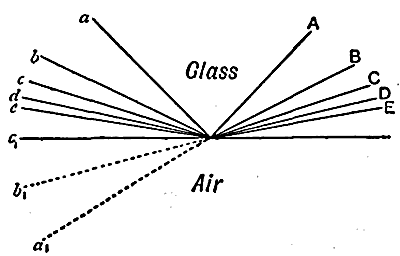
Take next the quality of brilliancy. This depends upon two things - first, the manner in which rays of light are affected when they enter or leave the stone, and, secondly, the manner in which this action can be intensified by the art of the lapidary.
When light passes from one transparent substance to another it is bent or refracted, as every one knows from the bent appearance of a stick plunged into water. Consider, now, a ray of light falling upon the surface of a transparent stone; a portion of the light is reflected, but a portion enters the stone. In passing from air into the stone it is refracted inward. When, on the other hand, it passes from a transparent stone into air, its course is reversed and the emerging ray is refracted outward or toward the surface. It is, however, with the emerging as with the entering light, the beam is subdivided, only a portion is refracted out, another portion of the light is reflected within the stone.
Continue to:


My Books

