


The Decorative Treatment Of Natural Foliage. Continued
Description
This section is from "Scientific American Supplement". Also available from Amazon: Scientific American Reference Book.
The Decorative Treatment Of Natural Foliage. Continued
| ART POLE.................................................SCIENCE POLE | |||
| Realism (See § 10). | Conventionalism (See § 14). | Disguised Artificialism (See § 6). | Botanical Analysis (See § 5). |
&Sect; 5. - The Botanical Analysis Treatment
In this method the student was taught (i) to draw each plant with the Stem straightened out, the Leaves flattened out, and the Flowers represented as in side elevation or plan. (ii) The Flowers were further pulled in pieces, and the Petals were flattened out in a manner similar to the Entomologists' practice of displaying their "specimens" scientifically. Often, also (iii) the Stems and Buds were cut through; and "patterns" were made with the Sections.
With regard to the first of these practices (i): it should be observed that much of the beauty of appearance of natural foliage results from the variety of view, the subtile curvature, and the foreshortening, as seen in perspective; and that to sacrifice all these for the sake of a diagram would be a wasted opportunity.
With regard to the other practices (ii) and (iii): it is obvious that these statements of the facts of the plant are useful as a part of the Science of Botany; but can no more be considered as making Decoration than Anatomical diagrams can be looked upon as Pictures. Some knowledge of external Botany is useful to a Pattern artist as some knowledge of external Anatomy is useful to the Pictorial artist. In each of these cases, the Science, which discovers and records facts, is subservient to its sister, Art, which uses the facts to interpret appearances; and, when scientific diagrams are put forth as Art, the Science is in its wrong place: it has then been treated as if it were the Building instead of being only the Scaffolding; and the results of such attempts cannot be considered as complete or final.
Examples of this method are given in Figs. 1 and 2. It was officially encouraged about twenty-five years ago; and books like "Plants, their Natural Growth and Ornamental Treatment," and "Suggestions in Floral Design," both by F. Edward Hulme, F.L.S., etc., show it at its best.
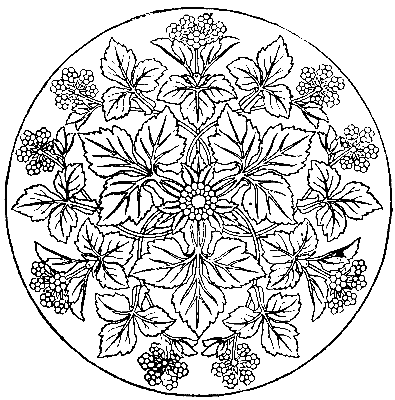
FIG. 1
In criticising this method, there is no desire to cast any slight upon those who were responsible for it. They were groping in the dark, and did the best they knew, according to their lights. But Japanese work was not known at that time, and, but for that, the Pattern artist of to-day might still be occupied in pinning leaves and flowers against the wall. It was, moreover, a protest against the Cabbage Rose on the Hearth rug, that some may still remember with shuddering.
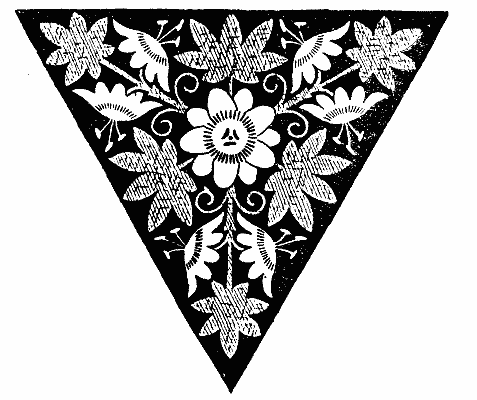
FIG. 2
&Sect; 6. - The Disguised Artificiality Treatment
In this method the student was taught to sketch out what he considered to be good Curves and Spirals; and then (i) to bend the selected plant so that its stem might coincide with them, regardless of its own proper natural growth; or (ii) to deck out the first drawn spirals with the leaves and flowers of the selected plant.
With regard to the first of these practices: it is much more foolish than the Analysis method; and is little short of blasphemy against the Great Designer. He has determined how each plant shall grow: how, within limits of cultivation, its stems and branches shall separate, each to seek its own share of air and sunshine; how its leaves shall stand erect or droop, each according to its function; and always in perfect beauty. And further: how each family of plants shall have its own method of branching; which is as much a part of its character and often of its beauty as are the Flowers and Leaves.
The second practice, which generally produces a result similar to the first, is quite as unthinking. It is more often practiced; and is responsible for many of the labored and uninteresting designs which are common. If the Pattern-artist deck-out the old worn-out and common place spirals with leaves and flowers borrowed from Nature - the result is like the "voice of Jacob and the hands of Esau;" it is merely a Disguise of Artificiality.
An example of this method is given in Fig. 3. It was generally practiced in Germany; and books like "Das Vegetabile Ornamente," by K. Krumbholz, show it at its best.
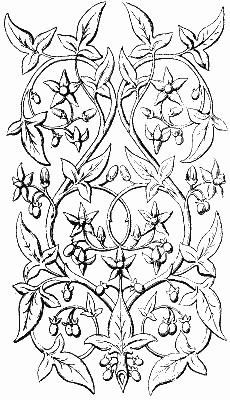
FIG. 3
If this treatment were universally followed - there would soon be an end to design with natural foliage. The spectator might observe one border which appeared to be a Rose, another a Tulip, the third a Thistle, and the fourth a Fuchsia; and, on examination, discover that these were not Rose, Tulip, Thistle, and Fuchsia; but merely that very artificial old friend - the Spiral-scroll - in disguise.
An apologist for this method remarks: - " ... In such matters as the ramification of plants, ... nature is always making angles and elbows [sic] which we are obliged, in decorative treatment, to change into curves for our purpose;...". This opinion needs only to be applied to animals in order to exhibit its absurdity; and with regard to plants, it will be seen that this tampering has not even the poor merit of success.
&Sect; 7. - Note On Symmetry
A desire for Symmetry often accompanies these two treatments. This is a quality to be avoided whenever possible in Natural foliage design. The so-called "Turn-over patterns" are an economy in Weaving-design, but the economy is of the wrong kind. An artist should spend his thought to spare material or cost in working. When he spares his thought - making the least amount of thought cover the greatest amount of surface - then is his work worth to the world just what it has cost him, i.e., very little.
So injurious is the influence of Symmetry in Natural foliage design, that it might almost be a test question - "Is the design symmetrical?" When the exigencies of Machine-reproduction necessitate this with Natural foliage - it is a hardship which the Artist regretfully accepts, and no one would willingly make a design for Hand-reproduction which was symmetrical; rather would he spend himself to insure the worthier result which ensues from Balance.
An example of Symmetry is given in Fig. 4; and of Balance in Fig. 5. Each panel contains two classes of Elements: - Natural foliage (i.e., two branches of the Bay tree), and an Artificial object (i.e., a Ribbon which ties them). The lower Element (i.e., the Ribbon) is treated symmetrically in both panels: the higher Element (i.e., the Branches) are symmetrical in the former panel, and balanced in the latter. This latter treatment, will be seen to be not only the more interesting, but the more like the infinite variety of Nature; while the former is a wasted opportunity, and contrary to Nature.
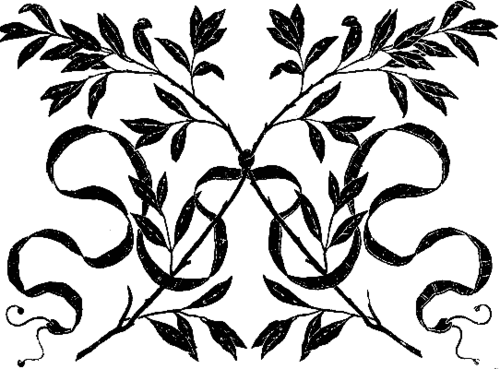
FIG. 4
The Student will observe by experience that the mind soon tires of Artificiality, both in Curvature and in Symmetry; the lines of Nature have a pleasant freshness and inexhaustible variety; and the Natural method of treating Nature is not only the most true, but also the most beautiful.
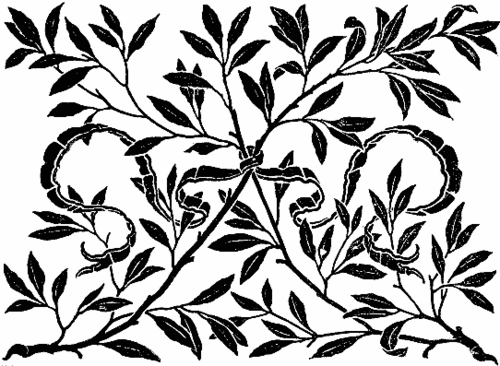
FIG. 5
&Sect; 8. - Realism And Conventionalism: Definitions
REALISM - the result of Realistic treatment, i.e., the attempt to render the reproduction as like the reality as is possible, even to the verge of deception - is the aim of the Pictorial-Artist. In Pictures the surface appears to have been annihilated, and the spectator beholds the scene as if there were a hole through the wall. It is not the highest, and should not be the only aim in Art; but it has always been sought for and admired. It requires perfect conditions, of materials and tools; i.e., complete Technical appliances.
CONVENTIONALISM - the result of incomplete Technical appliances, and the attempt to render so much of the Beauty of the original as is possible, with due regard to their capabilities - is the aim of the Decorative-Artist. It is not the highest aim; though a necessary curb in Decorative-Art, both for the technical reason, and also as a result of the Position or Function of the object.
It will thus be seen that the two words, when used with regard to foliage of any kind, refer to the Method of representing it, and not to its Kind or its manner of Growth.
&Sect; 9. - Scales From Realism To Conventionalism
These two methods, when applied absolutely, form the two extremes: - The most complete REALISM being at one end, and the most limited CONVENTIONALISM at the other. There are scales of gradual reduction between them, which may be shown on two charts:
(i) Reduction in the NUMBER OF PARTS which preserve their Realistic rendering.
(ii) Reduction in the DEGREE OF REALISM through all parts.
(i) According to the number of the features or parts of the design which are treated with less than realism. Thus there might be a panel representing a Window-opening with an architectural framing, with a Flower-vase on the sill, and a Landscape-background. The first part to be reduced in realistic rendering would be the Background, the second would be the Framing, leaving the third, the Flower-vase, as the survival. This is a Scale of reduction in Number of Parts.
It may be shown, in tabular arrangement, thus: -
| REALISM.........................................................CONVENTIONALISM. | |||
| COMPLETE PICTORIAL REALISM, in which all parts are realistically represented (see § 10). | SEMI-PICTORIAL REALISM, in which the Back-ground is reduced to a flat-tint, while all the remaining parts are realistically represented (see § 11). | DECORATIVE REALISM, in which the chief Feature (only) is realistically represented, and all the other parts ar reduced to conventional renderings (see § 12). | COMPLETE CONVENTIONALISM, in which all parts are reduced to conventional renderings (see Conventionalism). |
Inasmuch as there is some realistic part remaining in each of the first three methods - these are classified under the heading of REALISM.
(ii) According to the Degree in which color, gradation, or shading, is sacrificed, in consequence of the limited Means at the disposal of the Artist; resulting in the gradual departure from Realism to the most severe Conventionalism. The reduction is applied to all parts of the work. This is a scale of reduction in Degree. There are two Varieties in each degree; and they are marked with italic letters.
It may be shown, in tabular arrangement, thus: -
| REALISM............................................................CONVENTIONALISM. | ||||
| COMPLETE REALISM, in which all parts are represented, in proper colors, and perfect gradation, with correct light and shade (see § 10). | FIRST DEGREE OF CONVENTIONALISM, in which all parts are represented: (a) By a reduced number of Pigments, the other qualities remaining; (b) By reduction in gradation and shading to Flat-tints of several pigments (see § 15). | SECOND DEGREE OF CONVENTIONALISM, in which all parts are represented: (c) By a reduction to Monochrome of color, with Gradation (only) remaining; (d) By reduction to Monochrome of White and Black, with Gradation (only) remaining (see § 16). | THIRD DEGREE OF CONVENTIONALISM, in which all parts are represented: (e) By reduction to a Flat-tint of one pigment on a ground of another; (f) By reduction to a Flat-tint of White on Black, or vice versa (see § 17). | ULTIMATE CONVENTIONALISM, in which all parts are represented; (g) By reduction to Outline of several pigments; (h) Reduction to Outline of one pigment (see §18). |
Inasmuch as Realism ceases so soon as any reduction in the three qualities (of color, gradation, and shadow) is introduced; and the treatment becomes more Conventional in each method after the first - these are classified under the heading of CONVENTIONALISM.
[There is an analogous scale of reduction in Form, from the Complete-relief of an isolated Statue to the Flatness of a Floor-plate; but this does not belong to the present subject.]
[1]Lectures before the Society of Arts, London, 1891.
Continue to:


My Books

