


The London Paris Telephone. Part 2
Description
This section is from "Scientific American Supplement". Also available from Amazon: Scientific American Reference Book.
The London Paris Telephone. Part 2
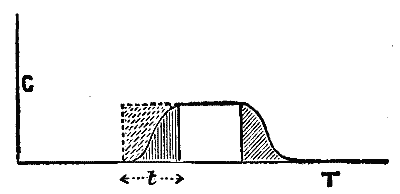
FIG. 1.
(b.) The internal opposition arises from the resistance, R, the capacity, K, and the electromagnetic inertia, L, of the circuit. A current of electricity takes time to rise to its maximum strength and time to fall back again to zero. Every circuit has what is called its time constant, t, Fig. 1, which regulates the number of current waves which can be transmitted through it per second. This is the time the current takes to rise from zero to its working maximum, and the time it takes to fall from this maximum to zero again, shown by the shaded portions of the figure; the duration of the working current being immaterial, and shown by the unshaded portion.
The most rapid form of quick telegraphy requires about 150 currents per second, currents each of which must rise and fall in 1/150 of a second, but for ordinary telephone speaking we must have about 1,500 currents per second, or the time which each current rises from zero to its maximum intensity must not exceed 1/3000 part of a second. The time constant of a telephone circuit should therefore not be less than 0.0003 second.
Resistance alone does not affect the time constant. It diminishes the intensity or strength of the currents only; but resistance, combined with electromagnetic inertia and with capacity, has a serious retarding effect on the rate of rise and fall of the currents. They increase the time constant and introduce a slowness which may be called retardance, for they diminish the rate at which currents can be transmitted. Now the retardance due to electromagnetic inertia increases directly with the amount of electromagnetic inertia present, but it diminishes with the amount of resistance of the conductor. It is expressed by the ratio L/R while that due to capacity increases directly, both with the capacity and with the resistance, and it is expressed by the product, K R. The whole retardance, and, therefore, the speed of working the circuit or the clearness of speech, is given, by the equation
(L / R ) + K R = t
or
L + K R² = R t
Now in telegraphy we are not able altogether to eliminate L, but we can counteract it, and if we can make Rt = Q, then
L = - K R²
which is the principle of the shunted condenser that has been introduced with such signal success in our post office service, and has virtually doubled the carrying capacity of our wires.
K R = t
This is done in telephony, and hence we obtain the law of retardance, or the law by which we can calculate the distance to which speech is possible. All my calculations for the London and Paris line were based on this law, which experience has shown it to be true.
How is electromagnetic inertia practically eliminated? First, by the use of two massive copper wires, and secondly by symmetrically revolving them around each other. Now L depends on the geometry of the circuit, that is, on the relative form and position of the different parts of the circuit, which is invariable for the same circuit, and is represented by a coefficient, λ. It depends also on the magnetic qualities of the conductors employed and of the space embraced by the circuit. This specific magnetic capacity is a variable quantity, and is indicated by μ for the conductor and by μ for air. It depends also on the rate at which currents rise and fall, and this is indicated by the differential coefficient dC / dt. It depends finally on the number of lines of force due to its own current which cut the conductor in the proper direction; this is indicated by β. Combining these together we can represent the electromagnetic inertia of a metallic telephone circuit as
L = λ (μ + μ) dC/dt × β
Now,
λ = 2 log ( d2 / a2)
Hence the smaller we make the distance, d, between the wires, and the greater we make their diameter, a, the smaller becomes λ. It is customary to call the value of μ for air, and copper, 1, but this is purely artificial and certainly not true. It must be very much less than one in every medium, excepting the magnetic metals, so much so that in copper it may be neglected altogether, while in the air it does not matter what it is, for by the method of twisting one conductor round the other, the magnetization of the air space by the one current of the circuit rotating in one direction is exactly neutralized by that of the other element of the circuit rotating in the opposite direction.
Now, β, in two parallel conductors conveying currents of the same sense, that is flowing in the same direction, is retarding, Fig. 2, and is therefore a positive quantity, but when the currents flow in opposite directions, as in a metallic loop, Fig. 3, they tend to assist each other and are of a negative character. Hence in a metallic telephone circuit we may neglect L in toto as I have done.
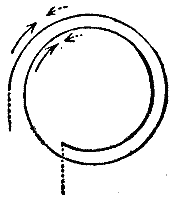
FIG. 2.
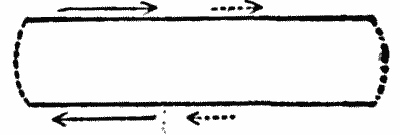
FIG. 3.
I have never yet succeeded in tracing any evidence of electromagnetic inertia in long single copper wires, while in iron wires the value of L may certainly be taken at 0.005 henry per mile.
In short metallic circuits, say of lengths up to 100 miles, this negative quantity does not appear, but in the Paris-London circuit this helpful mutual action of opposite currents comes on in a peculiar way. The presence of the cable introduces a large capacity practically in the center of the circuit. The result is that we have in each branch of the circuit between the transmitter, say, at London and the cable at Dover, extra currents at the commencement of the operation, which, flowing in opposite directions, mutually react on each other, and practically prepare the way for the working currents. The presence of these currents proved by the fact that when the cable is disconnected at Calais, as shown in Fig. 5, and telephones are inserted in series, as shown at D and D', speech is as perfect between London and St. Margaret's Bay as if the wires were connected across, or as if the circuit were through to Paris. Their effect is precisely the same as though the capacity of the aerial section were reduced by a quantity, M, which is of the same dimension or character as K. Hence, our retardance equation becomes
Continue to:


My Books

