


The System Of Military Dove Cotes In Europe
Description
This section is from "Scientific American Supplement". Also available from Amazon: Scientific American Reference Book.
The System Of Military Dove Cotes In Europe
France
The history of the aerial postal service and of the carrier pigeons of the siege of Paris has been thoroughly written, and is so well known that it is useless to recapitulate it in this place. It will suffice to say that sixty-four balloons crossed the Prussian lines during the war of 1870-1871, carrying with them 360 pigeons, 302 of which were afterward sent back to Paris, during a terrible winter, without previous training, and from localities often situated at a distance of over 120 miles. Despite the shooting at them by the enemy, 98 returned to their cotes, 75 of them carrying microscopic dispatches. They thus introduced into the capital 150,000 official dispatches and a million private ones reduced by photo-micrographic processes. The whole, printed in ordinary characters, would have formed a library of 500 volumes. One of these carriers, which reached Paris on the 21st of January, 1871, a few days previous to the armistice, carried alone nearly 40,000 dispatches.
The pigeon that brought the news of the victory of Coulmiers started from La Loupe at ten o'clock in the morning on the tenth of November, and reached Paris a few minutes before noon. The account of the Villejuif affair was brought from Paris to Tourcoing (Nord) by a white pigeon belonging to Mr. Descampes. This pigeon is now preserved in a stuffed state in the museum of the city. The carrier pigeon service was not prolonged beyond the 1st of February, and our winged brothers of arms were sold at a low price at auction by the government, which, once more, showed itself ungrateful to its servants as soon as it no longer had need of their services. After the commune, Mr. La Perre de Roo submitted to the president of the republic a project for the organization of military dove cotes for connecting the French strongholds with each other. Mr. Thiers treated the project as chimerical, so the execution of it was delayed up to the time at which we saw it applied in foreign countries.
In 1877, the government accepted a gift of 420 pigeons from Mr. De Roo, and had the Administration of Post Offices construct in the Garden of Acclimatization a model pigeon house, which was finished in 1878, and was capable of accommodating 200 pairs.
At present, the majority of our fortresses contain dove cotes, which are perfectly organized and under the direction of the engineer corps of the army.
The map in Fig. 1 gives the approximate system such as it results from documents consulted in foreign military reviews.
According to Lieutenant Grigot, an officer of the Belgian army, who has written a very good book entitled Science Colombophile, a rational organization of the French system requires a central station at Paris and three secondary centers at Langres, Lyons and Tours, the latter being established in view of a new invasion.
As the distance of Paris from the frontier of the north is but 143 miles at the most, the city would have no need of any intermediate station in order to communicate with the various places of the said frontier. Langres would serve as a relay between Paris and the frontier of the northeast. For the places of the southeast it would require at least two relays, Lyons and Langres, or Dijon.

FIG. 1. - THEORETIC MAP OF THE FRENCH SYSTEM OF MILITARY DOVE COTES.
As Paris has ten directions to serve, it should therefore possess ten different dove cotes, of 720 birds each, and this would give a total of 7,200 pigeons. According to the same principle, Langres, which has five directions to provide for, should have 3,600 pigeons.
Continuing this calculation, we find that it would require 25,000 pigeons for the dove cotes as a whole appropriated to the frontiers of the north, northeast, east, and southeast, without taking into account our frontiers of the ocean and the Pyrenees.
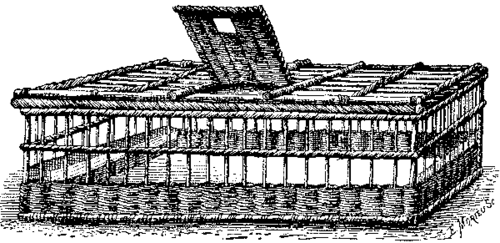
FIG. 2. - BASKET FOR CARRYING PIGEONS.
A law of the 3d of July, 1877, supplemented by a decree of the 15th of November, organized the application of carrier pigeons in France.
One of the last enumerations shows that there exist in Paris 11,000 pigeons, 5,000 of which are trained, and, in the suburbs, 7,000, of which 3,000 are trained. At Roubaix, a city of 100,000 inhabitants, there are 15,000 pigeons. Watrelos, a small neighboring city of 10,000 inhabitants, has no less than 3,000 carrier pigeons belonging to three societies, the oldest of which, that of Saint-Esprit, was founded in 1869.
In entire France, there are about 100,000 trained pigeons, and forty-seven departments having pigeon-fancying societies.
Germany
After the war of 1870, Prussia, which had observed the services rendered by pigeons during the siege of Paris, was the first power to organize military dove cotes.
In the autumn of 1871, the Minister of War commissioned Mr. Leutzen, a very competent amateur of Cologne, to study the most favorable processes for the recruitment, rearing, and training of carrier pigeons, as well as for the organization of a system of stations upon the western frontier.
In 1872, Mr. Bismarck having received a number of magnificent Belgian pigeons as a present, a rearing station was established at the Zoological Garden of Berlin, under the direction of Dr. Bodinas.
In 1874 military dove cotes were installed at Cologne, Metz, Strassburg, and Berlin. Since that time there have been organized, or at least projected, about fifteen new stations upon the frontier of France, upon the maritime coasts of the north, or upon the Russian frontier.
Berlin remains the principal rearing station, with two pigeon houses of 500 pigeons each; but it is at Cologne that is centralized the general administration of military dove cotes under Mr. Leutzen's direction. The other stations are directly dependent upon the commandant of the place, under the control of the inspector of military telegraphy. The Wilhelmshaven dove cote, by way of exception, depends upon the Admiralty. In each dove cote there is a subofficer of the engineer corps and an experienced civil pigeon fancier, on a monthly salary of ninety marks, assisted by two orderlies. In time of war, this personnel has to be doubled and commanded by an officer.
The amount appropriated to the military dove cotes, which in 1875 was about 13,000 francs, rose in 1888 to more than 60,000 francs.
As a rule, each dove cote should be provided with 1,000 pigeons, but this number does not appear to have been yet reached except at Thorn, Metz, and Strassburg.
Germany has not confined herself to the organization of military dove cotes, but, like other nations, has endeavored to aid and direct pigeon fancying, so as to be able, when necessary, to find ready prepared resources in the civil dove cotes. The generals make it their duty to be present, as far as possible, at the races of private societies, and the Emperor awards gold medals for flights of more than 120 miles.
On the 13th of January, 1881, nineteen of these societies, at the head of which must be placed the Columbia, of Cologne, combined into a federation. At the end of the year the association already included sixty-six societies. On the 1st of December, 1888, it included seventy-eight, with 52,240 carrier pigeons ready for mobilization.
The first two articles of the statutes of the Federation are as follows:
"I. The object of the Federation is to unite in one organization all societies of pigeon fanciers in order to improve the service of carrier pigeons, which, in case of war, the country must put to profit.
"II. The Federation therefore proposes: (a) To aid the activity of pigeon-fancying societies and to direct the voyages of the societies according to a determined plan; (b) to form itinerent societies and on this occasion to organize expositions and auction sales of pigeons; (c) to maintain relations with the Prussian Minister of War; (d) to obtain diminutions and favors for transportation; (e) to make efforts for the extermination of vultures; (f) to obtain a legal protection for pigeons; and (g) to publish a special periodical for the instruction of fanciers."
Italy
The first military dove cote in Italy was installed in 1876 at Ancona by the twelfth regiment of artillery. In 1879, a second station was established at Bologna. At present there are in the kingdom, besides the central post at Rome, some fifteen dove cotes, the principal ones of which are established at Naples, Gaeta, Alexandria, Bologna, Ancona and Placenza. There are at least two on the French frontier at Fenestrella and Exilles, and two others in Sardinia, at Cagliari and Maddalena. The complete system includes twenty-three; moreover, there are two in operation at Massoua and Assab.
The cost of each cote amounts to about 1,000 francs. The pigeons are registered and taken care of by a pigeon breeder (a subofficer) assisted by a soldier. The head of the service is Commandant of Engineers Malagoli, one of the most distinguished of pigeon fanciers.
We represent in Fig. 2 one of the baskets used in France for carrying the birds to where they are to be set free. - La Nature.
[1]Continued from Scientific American of July 11, p. 23.
Continue to:


My Books

