


The Whale-Headed Stork
Description
This section is from "Scientific American Supplement". Also available from Amazon: Scientific American Reference Book.
The Whale-Headed Stork
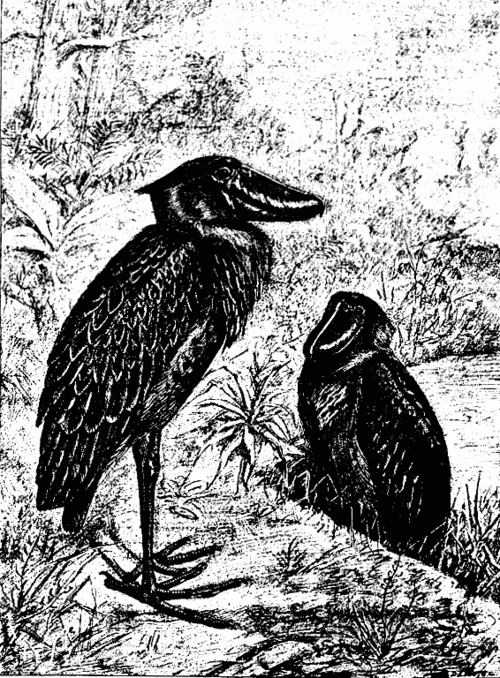
THE WHALE-HEADED STORK - BALaeNICEPS REX.
Of all the wonders that inhabit the vast continent of Africa, the most singular one is undoubtedly the Balaeniceps, or whale-headed stork. It is of relatively recent discovery, and the first description of it was given by Gould in the early part of 1851. It is at present still extremely rare. The Paris Museum possesses three specimens of it, and the Boulogne Museum possesses one. These birds always excite the curiosity of the public by their strange aspect. At first sight, says W.P. Parker, in his notes upon the osteology of the balaeniceps, this bird recalls the boatbill, the heron, and the adjutant. Other birds, too, suggest themselves to the mind, such as the pelican, the toucan, the hornbills, and the podarges. The curious form of the bill, in fact, explains this comparison with birds belonging to so different groups, and the balaeniceps would merit the name of boatbill equally well with the bird so called, since its bill recalls the small fishing boats that we observe keel upward high and dry on our seashores. This bill is ten inches in length, and four inches in breadth at the base. The upper mandible, which is strongly convex, exhibits upon its median line a slight ridge, which is quite wide at its origin, and then continues to decrease and becomes sensibly depressed as far as to the center of its length, and afterward rises on approaching the anterior extremity, where it terminates in a powerful hook, which seems to form a separate part, as in the albatrosses.
Throughout its whole extent, up to the beginning of the hook, this mandible presents a strong convexity over its edge, which is turned slightly inward. The lower mandible, which is powerful, and is indented at its point to receive the hook, has a very sharp edge, which, with that of the upper mandible, constitutes a pair of formidable shears. The color of the bill is pale yellow, passing to horn color toward the median ridge, and the whole surface is sprinkled with dark brown blotches. The nostrils are scarcely visible, and are situated in a narrow cleft at the base of the bill, and against the median ridge. The tongue is very small and entirely out of proportion to the vast buccal capacity. This is a character that might assimilate the balaeniceps to the pelican. The robust head, the neck, and the throat, are covered with slate-colored feathers verging on green, and not presenting the repulsive aspect of the naked skin of the adjutant. As in the latter, the skin of the throat is capable of being dilated so as to form a voluminous pouch. Upon the occiput the feathers are elongated and form a small crest. The body is robust and covered upon the back with slate-colored feathers bordered with ashen gray. Upon the breast the feathers are lanceolate, and marked with a dark median stripe.
Finally, the lower parts, abdomen, sides, and thighs, are pale gray, and the remiges and retrices are black. According to Verreaux, the feathers of the under side of the tail are soft and decompounded, but at a distance they only recall the beautiful plumes of the adjutant. The well-developed wings indicate a bird of lofty flight, yet of all the bones of the limbs, anterior as well as posterior, the humerus alone is pneumatized. The strong feet terminate in four very long toes deprived at the interdigital membrane observed in most of the Ciconidae. The claws are powerful and but slightly curved, and that of the median toe is not pectinated as in the herons.
The balaeniceps is met with only in or near water, but it prefers marshes to rivers. It is abundant upon the banks of the Nile only during the hot season which precedes the rains and when the entire interior is dried up. During the rest of the year it inhabits natural ponds and swamps, where the shallow water covers vast areas and presents numerous small islands, of easier access than the banks of the Nile, which always slope more or less abruptly into deep water. In such localities it is met with in pairs or in flocks of a hundred or more, seeking its food with tireless energy, or else standing immovable upon one leg, the neck curved and the head resting upon the shoulder. When disturbed, the birds fly just above the surface of the water and stop at a short distance. But when they are startled by the firing of a gun, they ascend to a great height, fly around in a circle and hover for a short time, and then descend upon the loftiest trees, where they remain until the enemy has gone.
Water turtles, fish, frogs and lizards form the basis of their food. According to Petherick, they do not disdain dead animals, whose carcasses they disembowel with their powerful hooked beak. They pass the night upon the ground, upon trees and upon high rocks. As regards nest-making and egg-laying, opinions are most contradictory. According to Verreaux, the balaeniceps builds its nest of earth, vegetable debris, reeds, grass, etc., upon large trees. The female lays two eggs similar to those of the adjutant. It is quite difficult to reconcile this opinion with that of Petherick, who expresses himself as follows: "The balaeniceps lays in July and August, and chooses for that purpose the tall reeds or grasses that border the water or some small and slightly elevated island. They dig a hole in the ground, and the female deposits her eggs therein. I have found as many as twelve eggs in the same nest."
The whale-headed stork is still so little known that there is nothing in these contradictions that ought to surprise us. Authors are no more in accord on the subject of the affinities of this strange bird. Gould claims that it presents the closest affinities with the pelican and is the wading type of the Pelicanidae. Verreaux believes that its nearest relative is the adjutant, whose ways it has, and that it represents in this group what the boatbill represents in the heron genus. Bonaparte regards it as intermediate between the pelican and the boatbill. If we listen to Reinhurdt, we must place it, not alongside of the boatbill, but alongside of the African genus Scopus. The boatbill, says he, is merely a heron provided with a singular bill, which has but little analogy with that of the balaeniceps, and not a true resemblance. The nostrils differ in form and position in those two birds, and in the boatbill there exists beneath the lower mandible a dilatable pouch that we do not find in the balaeniceps. An osteological examination leads Parker to place the balaeniceps near the boatbill, and the present classification is based upon that opinion.
The family of Ardeidae is, therefore, divided into five sub-families, the three last of which each comprises a single genus.
| Ardeidae. - | Ardeineae (herons). |
| Botaurineae (bitterns). | |
| Scopineae (ombrette). | |
| Cancomineae (boatbill). | |
| Balaenicepineae (whale-headed stork). |
All the whale-headed storks that have been received up to the present have come from the region of the White Nile; but Mr. H. Johnston, who traveled in Congo in 1882, asserts that he met with the bird on the River Cunene between Benguela and Angola, where it was even very common. Mr. Johnston's assertion has been confirmed by other travelers worthy of credence, but, unfortunately, the best of all confirmations is wanting, and that is a skin of this magnificent wader. We can, therefore, only make a note of Mr. Johnston's statement, and hope that some traveler may one day enrich our museums with some balaeniceps from these regions. The presence of this bird in the southwest of Africa is, after all, not impossible; yet there is one question that arises: Was the balaeniceps observed by Mr. Johnston of the same species as that of the White Nile, or was it a new type that will increase this family, which as yet comprises but one genus and one species - the Balaeniceps rex? - Le Naturaliste.
Continue to:


My Books

