


Wild And Domestic Sheep In The Berlin Zoological Garden
Description
This section is from "Scientific American Supplement". Also available from Amazon: Scientific American Reference Book.
Wild And Domestic Sheep In The Berlin Zoological Garden
As a rule, domestic animals are accorded very little space in zoological gardens, but, although it is doubtless the first duty of these popular institutions to show visitors animals which live in a wild state in foreign lands, it is well, where there is sufficient space and adequate means, to extend the limits of the collection so as to include natives of our own woods and fields, thus enabling people of a great city who are unfamiliar with nature to form an idea of the changes wrought in animal life by the influence of man, for domestic animals are a great aid in the study of natural history. The accompanying engravings are reproductions of instantaneous photographs of occupants of the new sheep and goat house - mostly foreign breeds; but there are a few that belong to that South European-Asiatic group which are looked upon as the progenitors of the domestic sheep: the mouflon, of Sardinia and Corsica (Ovis Musimon L.), which has a coat of brownish red, flecked with darker color; and the slender, long-legged, reddish-gray sheep of Belochistan (Ovis Blanfordi Hume). The first glance at these creatures convinces one that they are wild, not domestic sheep, an impression which is caused chiefly by the monotonous coloring and the dry, short coat, which bears no resemblance to the thick fleece of the tame sheep, although the eye is soon attracted by other differences, such as the shape of the tail, which is short and thick, and of the horns, which extend over the back and then turn inward, so that when the old ram is kept in captivity, it is necessary to cut off the points of the horns to prevent their boring into the flesh of its neck.
Horns of this shape form a strong contrast to those with snail-like windings and points standing away from the body. When looking at one of these sheep from the front, it will be noticed that the left horn turns to the right and the right horn to the left.
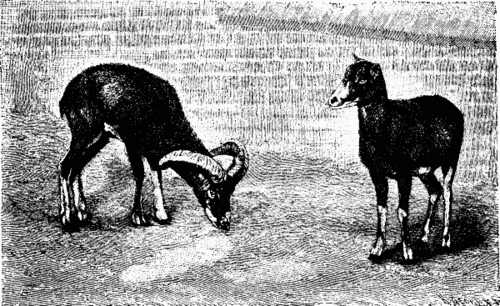 SARDINIAN MOUFLON (OVIS MUSIMON L.)
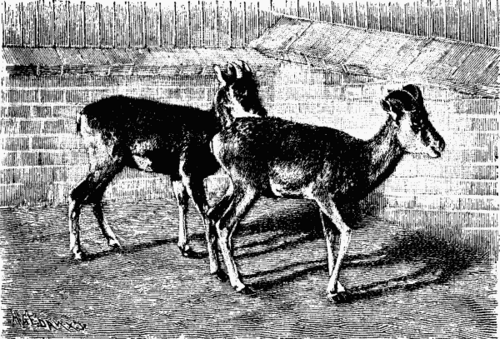 BELOCHISTAN SHEEP (OVIS BLANFORDI HUME).
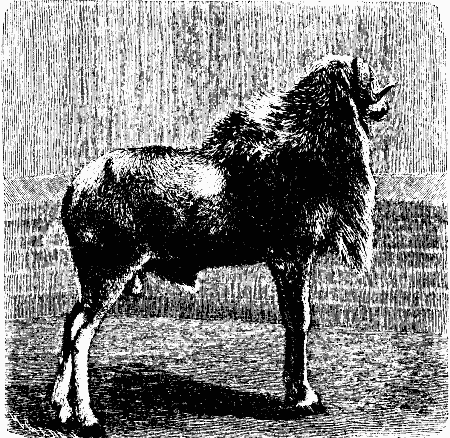 RAM FROM TUNIS.
Former authorities have been unwilling to admit that the domestic sheep have come from any species of wild sheep of the present time. They hold that they are the descendants of one or more species of wild sheep that are now extinct. Recently, however, men have thought more deeply and freely on such subjects, and Nehring and others have traced the modern tame sheep back to the mouflon, but not to him alone. It is thought that in this case, as with other domestic animals, there has been a mixture of species, and in this connection attention was directed to the Transcaspian arkal, the argalis of the interior of Asia and the North African species. Dr. Heck, director of the Berlin Zoological Garden, thinks that the horns of the tame ram, which are turned outward, the points being directed away from the body, constitute one of the strongest proofs that the blood of the argalis and its extinct European ancestors - which are known only by the fossil remains - flows in the veins of all domestic sheep.
The other characteristic marks of the domestic sheep - the wool and the length of the tail - vary greatly. The heath sheep - the little, contented, weather-hardened grazing sheep of the Lüneburg and other heaths - belong to one of the oldest species, and their tails are as short and their horns as dark as those of the moufflon. A cross between these two breeds is not distinguishable, even in the second generation, as has been shown by the interesting experiments in the Düsseldorf Zoological Garden.
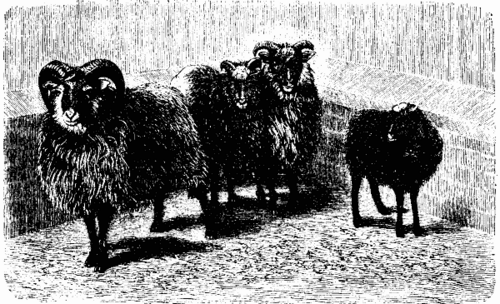 HEATH SHEEP.
The little, black and red-spotted Cameroons sheep, from the western coast of Africa, have not a trace of wool. But why should they have? The negroes need no clothing, and, consequently, they have not bred sheep with wool; and, besides, such an animal could not live in the tropics, even if the black man were a much better stock raiser and breeder than he is. The mane on the neck, and breast of the Cameroons ram reminds one of the North American sheep; but it must be remembered that the mouflon and arkal rams have this ornament quite clearly, although not so strongly defined.
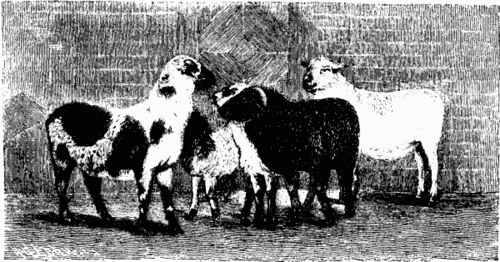 CAMEROONS SHEEP.
The large, short-bodied and long-legged sheep found in the interior of western and northern Africa are a complete contrast to the short-legged, long-bodied little Cameroons sheep. There is a very valuable pair of the former in the Berlin Zoological Garden - the Haussa sheep - which are very regularly marked, the front parts of their bodies being red and the hind parts white. They were brought from the neighborhood of Say, on the middle Niger, by the Togo Hinterland expedition. The ram has beautiful horns, and the ewe is distinguished by two strange, tassel-like pendants of skin that hang from her neck. This zoological garden also possesses a fine ram from the interior of Tunis, which is similar in shape to the Haussa ram, but has shorter horns and a heavier mane. Its color is grayish black.
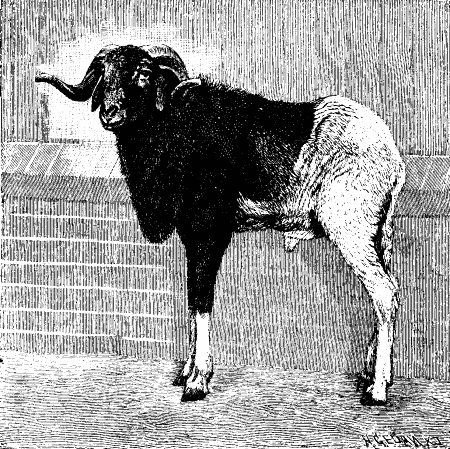 HAUSSA RAM.
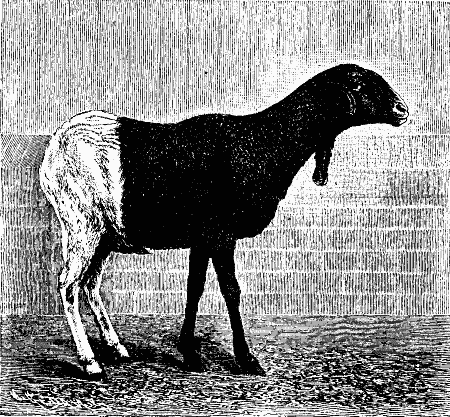 HAUSSA EWE.
Dr. Heck considers the long tail of the domestic sheep the chief impediment to the adoption of the theory of its descent from the short-tailed wild sheep. And yet, in sheep, this member is of secondary importance, for it varies greatly in form. The short-tailed heath sheep are just the opposite of the fat-tailed Persian sheep, which are represented in a fabulous account as being obliged to draw their broad tails, that weighed 40 pounds, behind them on wheels. These are the sheep that supply the Astrakan and Persian lamb which is so much worn now. The fur is caused to lie in peculiar waves or tight rings by sewing the newly born lamb in a tightly fitting covering which keeps the fur from being mussed. In the Berlin Zoological Garden there is a very fine four-horned, fat-tailed ram, from the steppes on the lower Volga. From this region come also the large-boned, fat-rumped sheep, which have a large mass of fat on each side of the stunted tail. In the illustration this peculiarity does not show well, on account of the thick winter wool. Their color is red, with dirty white.
When Wissman and Bumiller returned from their last expedition, they brought a fine ram of a different breed of fat-rumped sheep, which are raised by the Kirghise, on the Altai Mountains. They are smaller than those from the steppes of the Volga, but have finer wool, and evidently belong to a finer breed. As mutton tallow is very useful, and has been used even from the most ancient times by sheep raisers in the preparation of food, they prize sheep with these masses of fat on the tail and rump, which were purposely developed to the greatest possible degree.
 FAT-TAILED SHEEP (FOUR-HORNED RAM).
 FAT-RUMPED SHEEP.
The steinbock and the chamois, which live in the highest mountains, are still found, but other breeds, such as the argalis, which inhabited the foot hills and the high table lands, have disappeared, as Europe has become more thickly populated. We know that they formerly lived there, by the fossil remains of the oldest Pliocene in England (Ovis Savinii Newton), of the caves of bones near Stramberg in Moravia (Ovis argaloides Nehring), and of the diluvial strata near Puy-de-Dôme Mountain in the south of France (Ovis antiqua Pommerol).
For the above and the accompanying illustrations we are indebted to Daheim.
[Continued from SUPPLEMENT, No. 1172, page 18756.]
Continue to:


My Books

