


Chapter VIII. Deposits And Depositors
Description
This section is from the book "Banking, Credits And Finance", by Thomas Herbert Russell. Also available from Amazon: Banking, credit and finance (Standard business).
Chapter VIII. Deposits And Depositors
When you enter a bank to open an account, inquire for the cashier, and, if convenient, take with you some one who can introduce you and identify you as the person you profess to be.
If you go alone, do not feel hurt if a number of questions are asked you. While you may be perfectly honest, a large number of people make their living by being sharp, and, besides, it is necessary to establish those confidential relations which ought to exist in all financial transactions, so that' the cashier may know something more about you than he could ascertain by merely looking at you, and taking your name in a book.
The cashier will have you place your signature in a book. Your name as written in this book should be the same in style as you intend to place on your checks.
If necessary, the cashier or some officer of the bank, will show you how to make out a deposit slip. He will give you also a small bank book, in which you will be credited with the amount of money which you deposit. East time you deposit money you will be required to make out a deposit slip. The banks furnish the printed blanks free.
Under the word checks on the blank you write the names of the banks upon which the checks, if any, which you are depositing, are drawn. If a check is on a distant city, the name of the city should be given.
Your bank book is in reality your only receipt from the bank for the money you deposit. When you deposit money hand it to the receiving teller, and when you wish to draw money present your check to the paying teller.
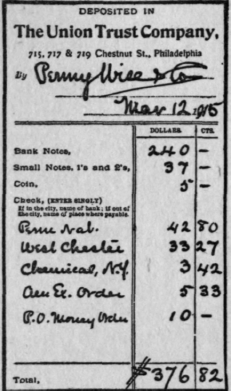
Deposit Slip.
When you wish to have your bank book balanced hand it to the receiving teller. This is usually done on the first of each month. The paid or canceled checks are returned to you in a day or two when you get your bank book back. These should all be filed in an orderly way. They serve as vouchers and may be useful in legal complications.
Continue to:


My Books

