


The Departments Of A Large Bank II. Part 9
Description
This section is from the book "Banking Practice And Foreign Exchange", by Howard McNayr Jefferson. Also available from Amazon: Banking Practice And Foreign Exchange.
The Departments Of A Large Bank II. Part 9
133. Loans On Insurance Policies
A banker is often requested to make a loan on the security of a life insurance policy. If the policy has a cash surrender value it is a safe loan so far as the security goes, but it may be a hard one on which to realize. Such loans usually have a sufficient amount of sentiment connected with them to compel the banker to make the loan. In most cases the policy is accepted by the banker more as a moral security than an actual security. Mr. George Rae in his book on "The Country Banker" says regarding life policies as collateral security:
But the inability to pay a sum owing to a bank has not ordinarily a fatal effect on the life of the debtor! It is frequently quite the reverse.
If the policy is accepted it should be assigned to the bank by the beneficiary and the assignment recorded with the company. The bank should see that all premiums are paid promptly as they fall due.
134. Care Of Securities For Customers
If a bank does not have a safe deposit department it is frequently called upon to hold securities for its customers, as custodian. New York City banks hold a great many of the investments of their country correspondents in this way. They usually buy the bonds for the banks in the first place. The country banks have not very strong vaults and avail themselves of the privilege of leaving their securities in New York. They thus save themselves the worry regarding their safety from burglars and fire. They do not have to cut the coupons when they fall due and forward them for collection, as the New York correspondent will gladly do it for them. Such bonds are usually bought and held as a safety fund or reserve in case of increased demand for money in their locality. If such a temporary demand arises the bonds are with the bank and instructions can be sent by telegraph to sell them and ship currency, or credit their account with a loan on the security of the bonds. When the bank wishes to sell the bonds they are in New York and the expressage has been saved to and from New York. The New York correspondent makes no charge for the vault space or services in connection with caring for the bonds.
The record of the custodian bank may be very simple. It may be kept in an ordinary ledger. The correspondent is credited with the securities received from or purchased for it. The record should show the date of receipt, how the bonds were received, the numbers and denominations of the certificates and the par value. In case of stocks, the record should show the numbers of the certificates, the number of shares and the names of the persons to whom the certificates are issued. There will be very few, if any, certificates of stock, unless the bank is acting as custodian for individuals. When securities are sold or delivered, the correspondent's account should be charged. The debit should show the date on which the securities were withdrawn, the date of the instructions, the disposition made, the numbers of the certificates and the par value.
The securities themselves should be filed in the vault in such, order that they can be produced with the least delay possible. Access to the securities should not be allowed to any one clerk or officer. If one clerk keeps the records of the securities, the second clerk should insist on seeing the written instructions from the correspondent before allowing any security to be withdrawn.
Some good form of tickler should be installed to call attention to the coupons that must be cut off and collected, and although another one is described later under investments, the Library Bureau card shown in Figures 106 and 107 on page 224 has some advantages and we will therefore describe it in this connection. The months of the year are printed on a slightly raised portion of the card, as shown in the figure. As soon as a lot of bonds is received for account of or from a correspondent for safe keeping, they are entered on a card having the proper maturity date, like the above, and filed alphabetically, by correspondents. It is possible to pick out all the cards having bonds with coupons maturing in a given month by running the eye along the tops of the cards and picking out the ones having that month's projection. These projections will be one behind the other throughout the list. To save rewriting the card for the September coupon, the card may be made with both a March and a September tab as shown in Figure 107 on page 224.

Figure 106. Coupon Tickler.
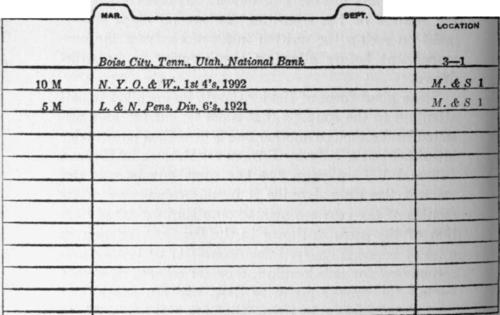
Figure 107. Coupon Tickler.
Some time before the coupons fall due a batch of cards are selected and taken to the vault in the morning. The number in the upper right hand corner indicates the number of the safe in which the securities will be found and the shelf on which they are placed. The bonds desired are taken from the bundle, the card slipped under the band and the whole handed to a clerk to cut off the coupons at a convenient time during the day. As the coupons are cut he will put them in a suitable envelope, writing the name of the owner thereon, together with the due date, the number, denomination and amount of the coupons. He will then slip the card under the band with the bonds. At the end of the day the securities are returned to the vault by the two clerks having charge of them and the cards to the file for future use.
If the bank is not opposed to loose-leaf or card records, it would be a very easy matter to enlarge these tickler cards and keep the entire record thereon instead of in the ledger and also on the tickler cards. If both records are used the tickler cards may be kept by the second clerk having the combination with the custodian and thus have a still better check on the securities held.
There is a danger in caring for these securities for customers, if certain checks of this kind are not established, for what would be easier than for a clerk having sole access to the securities to hypothecate a large block?
He would only have to pay the interest on the loan and see that the correspondent received credit for the coupons as they fell due. This business is not directly remunerative, but the courtesy extended to a country correspondent is an advertisement worth while.
Continue to:


My Books

