


Chapter IX. Exchanges; Collections; Letters Of Credit
Description
This section is from the book "The ABC Of Banks And Banking", by George M. Coffin. Also available from Amazon: The ABC of Banks and Banking.
Chapter IX. Exchanges; Collections; Letters Of Credit
In the chapter on "Loans and Discounts" and that on "Deposits," something has been said about "bills of exchange," "collections," "drafts" and "checks," all of which are related to the business of buying and selling "exchange," and this, being one of the most valuable services rendered by the present system of commercial banking, deserves a special chapter on the subject.
The word "exchange" is very aptly used to express the process constantly going on between banks all over the world, of "exchanging" checks, drafts, and other instruments calling for the payment of money between each other. Nowadays a bank in any part of the United States is apt to have offered to it for sale or for deposit a check, or draft, drawn on a bank or banker located either in some other part of this country or in some foreign country. The owner of the check will wish either to deposit it with the bank or to sell it. It may be the check of some party on a bank in some other place, or the check of one bank on another bank located elsewhere, like the following form:

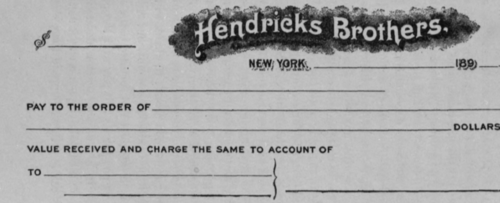
Or it might be the "draft" of one party on another in some other place, in the following form:
If the owner of the check or draft is a regular customer of the bank, it will take it on deposit for him, after he has endorsed it, crediting him with the "proceeds." This means such a sum as is left after the sum of "exchange," or discount, is deducted from the face of the check or draft. For checks drawn on banks in the United States this rate of exchange will vary according to the distance of the point where they are payable, from l-20th of 1 per cent, to l-4th of 1 per cent, or from 50 cents on each $1,000 to $2.50 on each $1,000. When the proceeds of the check are placed to the credit of the depositor, he is at liberty to draw against the amount, just as against any other deposit he may make. This deduction or discount is made to compensate the bank for the loss of interest to the bank until the amount advanced on the check is repaid to it, and for any expense it is at in collecting it. For instance, if a bank in New York takes from a customer a check on a bank in Cincinnati, it will deduct l-10th of 1 per cent for exchange or collection charges. Out of this it will probably pay a bank in Cincinnati, to which it sends it, l-20th of 1 per cent, for collecting it, besides the cost of postage, stationery, and clerical service involved in the transaction. If the owner of the check is not a regular customer of the bank or not in good credit, the bank will not pay him the money for it or credit his account, but will take it "for collection," which means it will forward it for collection, and when it receives pay for it, will pay over the proceeds to the owner, or credit his account, after deducting collection charges. Where a bank buys such a check or takes it on deposit, if the check is returned unpaid the owner or endorser is bound to refund the amount to the bank. At the close of business each day every bank separates the checks it has received on deposit or bought during the day into two classes: (1) those on banks located in the same city or place, which it exchanges the next morning with such banks, through the local "clearing house," as explained in the chapter on "deposits"; and (2) those drawn on banks or parties located in other cities or places, which it sends by mail that afternoon to banks called its "correspondents." These are banks located at central points all over the country, which agree to collect the cheeks on certain nearby points sent them at a certain charge, to be remitted for the day they are received or twice a week, or once a week, as may be agreed between the banks concerned.
As a rule, it is good business policy to send a collection item to a bank located at the place at which the item is payable, or if no bank is located there, then to one nearest to such a point. As a rule, also, a collection item should not be sent to the bank on which it is drawn, but to some other good bank located at the same place.
These principles, which apply to collection items between points in the United States known as "domestic exchange," are equally applicable to checks, drafts, etc., executed in this country, but drawn on banks or parties in foreign countries, known as "foreign exchange." Such items on Great Britain are usually expressed in pounds, shillings and pence; those on France in francs; those on Germany in marks, and so on. In these cases the foreign money must first be calculated in dollars and cents in United States money, after which the proper deduction for exchange must be made, depending, as in the case of domestic exchange, upon the time the money will.be invested and the cost of reimbursement to the bank buying the exchange, as well as the risk of loss involved in the transaction should the party on whom the item is drawn fail to pay on presentation or maturity.
Continue to:


My Books

