


Money as an Aid to Progress. Functions And Kinds Of Money. Chapter XV. A Measure of Value
Description
This section is from the "Commerce and Finance" book, by O. M. Powers. Amazon: Commerce and Finance.
Money as an Aid to Progress. Functions And Kinds Of Money. Chapter XV. A Measure of Value
Four Functions; Subsidiary Coin; Comparative Value of Silver And Gold; Demonetization Of Silver, Etc.
Money has four functions, viz.: 1. A medium of exchange. 2. A measure of value. 3. A standard of value for future payments. 4. A store of value.
Money is as essential to the interchange of commodities as language is to the interchange of ideas. Without some common medium of exchange it would be absolutely impossible to carry on the manufactures and commerce of the country. The rude system of bartering one product for another as the parties may each need, is only adapted to a low civilization where wants are few and simple. The history of civilization and progress is concurrent with the history of money. The breaking up of feudalism in the middle ages, and the growth of commerce, was due largely to the introduction and use of money, by which the vassals were able to pay their rent in money instead of services.
In order to effect exchanges of commodities there must be an equality of values, and in order to establish this equality of values a measure of value is necessary. A measure of value in the exchange of commodities is as necessary as the yard stick or pound weight in measuring quantities. It is useless to convert all things into terms of money as a medium of exchange unless this is done at certain rates, for without fixing the rate or measure of value between commodities no exchange is possible. In this country the standard unit of value is the gold dollar consisting of a certain amount of gold and alloy fixed by act of Congress, and all values are measured in dollars or parts of a dollar. Although the gold dollar is the standard, it is not necessary that all payments be made in gold dollars. We use silver, nickel, copper and paper as actual mediums of exchange, but of course they are all founded upon the gold dollar as the standard. A farmer agrees to pay a fixed proportion of his produce as rent, say one-third of his corn, but when the time arrives for payment he may, by agreement with the landlord, pay in gold, silver, paper, wheat, cattle or any other commodity, the quantity being measured, of course, by the value in gold dollars. In other words, the medium of exchange or payment may be different from the measure of value. We may measure in one thing, and pay in another. The medium of exchange would be useless unless measured in terms of the standard, and the measure would be useless without some medium of exchange by which the transaction could be carried out. A person having an article for sale desires to know what its value is, compared with other articles; that is, to have it measured by a common, recognized standard of value, but he also desires that, when he is ready to sell the article, there shall be a medium of exchange by which, he can dispose of all, or as much of it as he desires, without having to resort to the primitive system of barter.
Since many contracts involve the payment of money at some distant future time it is essential that money should possess stability or uniformity of value. Suppose that in the case of a lease for many years the tenant agrees to pay a fixed rental in gold, and during the term of the lease the production of gold at the mines should be greatly increased - doubled, say. The result would be that the value of gold would diminish and its purchasing power would be reduced. Prices of other commodities would rise. A gold dollar would not buy as much of anything as it did before. Now the tenant would be able to sell his goods at higher prices but his rent would remain the same in dollars. In this case the landlord would suffer a disadvantage. Suppose, on the contrary, that the mines failed to yield the customary amount of gold for a series of years and gold became scarce. Its scarcity would increase its value. Then a dollar of gold would have greater purchasing power and prices of other commodities would fall. The rent under this long term lease would remain the same, however, and the tenant must now pay his rent in dearer money. The landlord in this case would reap an advantage, as he would be getting a higher rent - the same rent nominally, but of greater purchasing power. .
The whole fabric of the business world is made up of an endless series of contracts, many of them extending into years of futurity for their fulfillment, such as contracts for future delivery of goods, leases of houses and lands, hiring of services for a term of years, the settlement of estates of inheritance to be made upon the maturity of minors, or the payment of pensions, annuities or life insurance, and it is important in all such undertakings that the money which is our standard of value now, and the basis on which the contract is made, shall continue uniform and finally possess the same value or purchasing power at the end of the period of time for which the contract runs.
Were our standard of value such a commodity as wheat, an abundant crop would diminish its purchasing power and correspondingly raise prices of other commodities and vice versa to the serious injury of one class and the benefit of another. Fortunately for the commodity gold, which all of the most advanced nations have chosen as their standard of value, its production is remarkably uniform. The earth yields a constant and never-failing supply of the precious metal, not of such abundance as to affect its value or relieve man of the necessity of giving back value in labor for value in gold received, yet in sufficient measure to repay the effort in seeking and mining it. It costs substantially a dollar in labor generally to get a dollar's worth of gold out of the earth and coin it into money. Thus gold is especially adapted to perform this function of the money standard of value for future payments.
Money may be said to perform a fourth function - that of a convenient means of storing value. When acting as a medium of exchange it circulates back and forth in the same locality, and may sometimes return to the same person, but at times a person desires to condense his wealth into small space and perhaps transport it to a distant country, or hoard it away for a time. Money in the form of the precious metals affords a convenient means of doing this. It is true that other commodities of small bulk, imperishable quality, and great value, such as diamonds or other precious stones, might be used for hoarding, and sometimes are, but their value is not affixed or stamped thereon, and their future value may not be uniform or stable. Gold coin is an exceptionally convenient means of hoarding or transporting money, and the facility with which it can be hoarded has a manifest tendency to beget economy and encourage accumulation, especially among the industrial classes. The large number of savings banks throughout the United States, with their enormous total of deposits and millions of depositors, is largely the effect of frugality and saving caused by the facility which the precious metals afford for hoarding or storing value.
Subsidiary coin or "token money" may be defined as coin, the nominal value of which as money is greater than its value as metal, even making allowance for the cost of coinage. When the government in 1834 changed the legal rate of silver to gold from 15 to 1 to the ratio of 16 to 1, making sixteen grains of pure silver equal to one of pure gold, the silver dollar then became of greater value than the gold dollar by 21/4 cents. Naturally people preferred to pay their debts in the cheaper metal, gold, and silver ceased to circulate. People who had silver on hand either converted it to other uses or sold it to brokers who melted it into bullion and exported it to other countries where its full value could be realized. We were then without silver for fractional currency, except worn halves, quarters and dimes which had lost 2 1/4 per cent, of their value by abrasion, and hence were equal in value to so many cents in gold. Then the increased supply of gold from California in 1850 caused a still further advance of 1 3/4 per cent, in the price of silver, driving still more of the white coin out of the county, and causing the remaining coins to be still lighter and smoother. To remedy this difficulty and supply the country with silver for fractions of a dollar, Congress in 1853 passed a law providing for the coinage of new silver half dollars, quarters, dimes and half dimes about seven per cent lighter than the former ones. There being no inducement to melt these coins into bullion or export them, they circulated at par with gold (except during the suspension of specie payments), although their metallic value was considerably less than their nominal value as silver. This was the beginning of silver as subsidiary coin in the United States.
The price of silver continued to fall, as compared with gold, until 1874, but during all of this time no silver dollars were in circulation, silver being worth more than gold. In 1873 Congress passed an act demonetizing silver. The metal in the silver dollar at the time of the passage of the demonetization act was worth two cents more than a gold dollar, but the price of silver has since continued to decline until it has become worth less than half its nominal value*. It now circulates freely as subsidiary coin, since the amount of silver coined and in circulation is limited and it is receivable for all.public dues. Receiving it for public dues is one way of redeeming the coin. Besides silver we have subsidiary coin in the form of fractional currency, consisting of copper and nickel. These are redeemable by the government in gold when presented in sums of twenty dollars or more. Paper money consists of printed promises to pay a given sum of money to the holder on demand. It is the government's promise to pay. It is not money, in reality, but represents money, and circulates instead of the actual coin. We call it money because it circulates from hand to hand and performs some of the functions of money, and because it will purchase our wants the same as money. It is redeemable or convertible into actual money on demand, and is issued either directly by the government or by banks under the authority of the government. There are several important advantages in favor of the use of paper money. It is lighter than coin and hence more convenient to carry in the pocket. Coin loses by abrasion, but paper can be readily replaced with new. Paper money can be sent through the mails or transported by express much more easily than coin.
•Congress passed an act in February, 1878, remonetizing silver, but notwithstanding this its value has continued to fall, and it only circulates at its nominal value because the Government receives it at the equivalent of gold at the custom house and tax office.
Paper money may be divided into two kinds, distinguished on account of the origin of each, viz., Fiat Money and Representa-tive money. These may be further subdivided as follows:
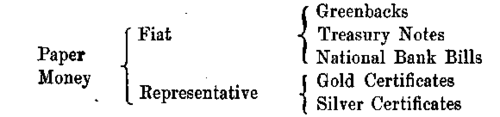
Fiat money consists of promises to pay by the government direct, or by banks under authority and control of the government, founded upon the faith of the people in the stability and credit of the government. Such bills are issued under a special law which limits the quantity, pledges the government to redeem them in gold on demand, and provides for a sufficient reserve fund of gold coin, to be kept on hand to redeem the bills in circulation.
Continue to:


My Books

