


Population And Immigration. Part 5
Description
This section is from the "Economics In Two Volumes: Volume II. Modern Economic Problems" book, by Frank A. Fetter. Also available from Amazon: Economic
Population And Immigration. Part 5
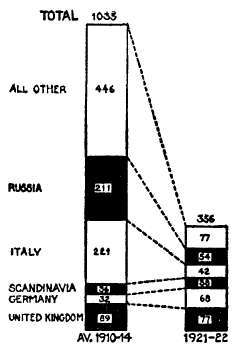
§ 15. Post-war restriction of immigration. Many events of the war period, and particularly of the years 1917 and 1918, affected greatly American opinion on the immigration question. That large part of our alien population which was from the allied countries or from disaffected races (such as the Poles and the Czechs) and from neutral countries assumed their full share of the military and other patriotic duties of the time; as did many natives of the Central Empires. But in many cases were revealed our lack of national unity and consciousness as a result of recent immigration, the failure of the "melting-pot" to melt, and widespread sedition and disloyalty among the aliens who had been welcomed to our shores. In the period of agitated feelings, of unsettled labor conditions, and of a threatening Bolshevism, the desirability of a "wide-open" policy of immigration came to be doubted in the very circles where immigration had been most strongly favored before. Large employers and the well-to-do classes recognized the threat to our institutions in the presence here of so many alien elements, un-American in thought and feeling, and embittered against all established political and economic institutions as a result of their experiences in their native lands. The first legislative fruit of this public opinion was the enactment by Congress of the temporary restriction law, which went into effect June 3, 1921. Of several restrictive laws that have passed both houses of Congress since Cleveland's administration, this was the first that was signed by the President. It limits (to the end of the fiscal year 1922) the immigration from each foreign country to 3 per cent of the number in the United States by the census of 1910. Immigration had already begun to rise to the pre-war rate. In the fiscal year ending June 30, 1921, immigrants to the number of 805,228 were admitted, while 247,718 departed, making a net addition of 557,510. The total number that can be admitted under this law, if each country sent its full quota, would be 354,000. This law, if supplemented by other legislation before 1922, will have inaugurated a new era of immigration policy in the United States.
16 See above, § 7; also ch. 22, § 9.
17 See above, § 2, note; also Vol. I, p. 422.
§ 16. Population and militarism. In view of the recrudescence of the spirit of armed national aggression apparent in the outbreak of the Great "War in 1914, the military aspect of the population question deserves serious consideration. The growth of savage and barbarian tribes in numbers, so that their customary standards of living were threatened, frequently has led to the invasion and conquest of their neighbors.18 To-day nations on a higher plane of living are probably repeating history. The nation with an expanding population is tempted to seek an outlet for its numbers and for its products by entering upon a policy of commercial expansion, which in turn has to be supported by stronger military and naval establishments. It is led by primitive impulses that to itself seem to be a moral justification, to possess the territory of its neighbors. Such a nation points to its increasing population and declares that it must have its "place in the sun"; it must find lands and food for its swarming numbers. Other nations with lower birth-rates and higher standards of living, which they seek to preserve by various measures excluding immigration, appear to be greedy, malevolent, and insulting. These are not the conditions for rational thinking. The immediate occasion of war may be some matter of internal polities, such as growing discontent and democratic sentiment among the people, while the deeper cause is the pressure of population in a limited territory. Nations with slowly growing populations, and still possessed of ample territories to maintain their accustomed standards of life, naturally favor the status quo, and are pacifist or non-militarist. If they arm, it is for their own safety. In this view, militarism is seen to consist, not in having drilled soldiers and stores of munitions, but in the national state of mind that would use these for aggression, not merely for defense. When, therefore, a powerful nation has reached a certain stage in the relation of its population to resources, limitation of population more truly than limitation of armaments is the real pacifism; and increase of population, not increased military training or a larger navy, is the real militarism.
Fig. 5, Chapter 25. Immigration restriction law of 1921; restrictive effects upon various nationalities, shown graphically.
18 See Vol. I, p. 412, on war and the pressure of population.
§ 17. Problem of maximum military power. It is a grave question, however, how far a nation with a relatively sparse population, high wages, and great wealth can safely limit population in the presence of a capable, ambitious, and efficient rival that covets such opportunities. On the one hand, a population may be so sparse that it has not soldiers enough to defend its territory against a numerous enemy; on the other hand, it may be so dense, and consequently average incomes be so low, that it cannot properly train, arm, and support its population of military age. The recent developments in the art of warfare call for great use of the mechanical industries, for great power to endure taxation, and for great financial resources, conditions found only where the average of national income is high. The point of maximum military power must be far short of the maximum possible population. It would seem that a nation of 100,000,-000 inhabitants favorably situated to resist aggression, well supplied with the natural materials for munitions, and well equipped to produce them, might safely limit its numbers so as to insure a high level of popular income. This safety would be greatly increased by permanent alliance with other peoples likewise limiting their numbers and, therefore, interested in maintaining the peace of the world. In this way it would be possible for them all to maintain a standard of popular well-being even higher than is fully consistent with the maximum military power, even in the presence of prolific and aggressive rival nations.
References
Adams and Sumner, ch. III.
Commons and Andrews, ch. II, sec. 4.
Commons, J. R., Races and immigrants in America. Revised. 1920.
Davis, P., Immigration and Americanization. Selected Readings.
Bost. Ginn. 1920. Fairchild, E. P., Immigration. 1913.
The standard of living - up or down? A. E. Rev., 6: 9-25.
•1916. Fetter, F. A., Population or prosperity. A. E. Rev., 3 (no. 1, supp.) : 5-19. 1913. (Presidential address before the American Economic Association, 1912; partly incorporated with chap. 25 in the text.) Foerster, R. F.. The Italian emigration of our times. Pp. 558.
Cambridge. Harvard University Press. 1919. Goldenweiser, E. A., Walker's theory of immigration. Am. J. Soc.,
18: 342-351. 1912-1913. Grant, M., The passing of the great race. Pp. 245. New York. Scribners. 1916. Hamilton, W. H., Readings in current economic history. P. 384- 386, 392-395. Univ. of Chic. Press. 1914. Jenks, J. W., and Lauck, W. J., The immigration problem. Pp. 605.
4th ed. N. Y. Funk. 1917. Materials for the study of elementary economics. 146-156. Chic.
Univ. Press. 1913. Millis, H. A., Some economic aspects of Japanese immigration.
A. E. Rev., 5: 787-804. 1915. Roberts, Peter, The new immigration. N. Y. Macmillan. 1912. Ross, E. A., The old world in the new. N. Y. Century. 1914. Warne, F. J., The tide of immigration. N. Y. Appleton. 1916.
Continue to:


My Books

