


Railroad Regulation. Part 3
Description
This section is from the "Economics In Two Volumes: Volume II. Modern Economic Problems" book, by Frank A. Fetter. Also available from Amazon: Economic
Railroad Regulation. Part 3
§ 6. The commission's powers strengthened. The latest era, that of strong federal regulation, preluded by the passage of the Elkins Act in 1903, aimed at discrimination and rebates, began definitely with the Hepburn Act of 1906. The Commission was increased to seven members, its authority was extended to include express, sleeping-car, and other agencies of transportation, and it was given the power to fix maximum rates, not to be suspended by the courts without a hearing. It became thus unquestionably a commission of the "strong type." It began to exercise its new powers with vigor, and the carriers reluctantly accepted its authority, as an evil less than that of "forty-nine masters." Responsive to a calmer but insistent popular demand, further amendments were made by the Mann-Elkins Act of 1910, which strength-ended the long- and short-haul clause, and gave to the Com-mission, among other new powers, that of suspending new rates proposed by carriers. A special Commerce Court of five judges was created with exclusive jurisdiction in certain classes of railroad cases, but this was abolished after a short trial.
Now began by the Commission an exercise of effective power. Complaints and prosecutions constantly brought to light many graver violations and many hidden abuses and minor violations of the act. Though an ideal condition might never be attained, the evils of favoritism by public carriers seemed in the way to be ended. The Commission, having absolute control over rates, kept them down. According to public opinion, this was the Commission's chief duty.
Note: The main reason for the growing financial difficulties of the railroads, especially after 1915, is evident here. The increases in rates were tardy, and inadequate to keep pace with rising costs. The last large rate increase, effective in September 1920, occurred several months after wholesale prices had passed their peak and were rapidly falling, and traffic was declining.
§ 7. Fixed rates and declining net earnings. At this point a new feature appeared in the situation. The curve of general prices continued, with slight irregularities, to rise after 1897, and railroad wages had been about keeping pace, moving now a little behind and then ahead, as a result of concessions, of strikes, of threatened strikes, and of decisions in arbitration. Thus almost everything that railroads had to buy - repairs, equipment, materials, labor of all kinds, had been increasing, while the average of freight rates was somewhat decreasing.1 The result was decreasing railway net earnings, falling railway credit, rapid slackening of railway-building, and inadequate maintenance of existing equipment. Railroad facilities and capacity, despite substantial technical progress in some respects (size of engines, train loads, etc.), was not keeping pace with the growth of the population and of the business of the nation.
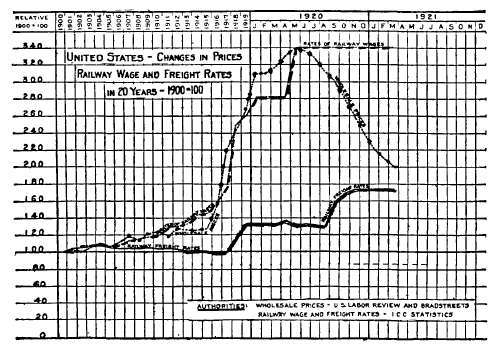
Fig. 2, Chapter 29.—Decline of railroad rates, relative to prices and railway wages, 1905-1920.
By 1914 the danger of this course began to be apparent to the public mind. The application of the roads for permission to raise various rates (in what was called, somewhat inaccurately, the "5 per cent case") was still opposed by the irreconcilable opponents of the roads. Many state railroad commissions united to oppose the granting of the application, and Mr. Louis D. Brandeis, as special counsel for the Commission, urged in a brilliant brief, half sophistical, half sound, that all of the additional revenues needed could and should be obtained by further economies in railroad management. In July, 1914, the Commission granted a part of the railroads' plea, the dissent of two members being on the ground that all was needed and should be granted. The Commission then by successive orders came over by the following December to the view of the minority, and granted further increases. Even this relief proved to be quite inadequate, as prices rose in 1915, making railway rates, relative to the monetary values of the goods transported, less than ever before. But in principle and as a precedent, this action of the Commission was important, for it reflected a change of public opinion. A good part of the public had begun to glimpse the truth that it is the duty of a public authority with absolute rate-fixing power to fix rates high enough as well as to keep them low enough; and they are not high enough if they do not give a return sufficient to maintain the existing plant and to attract new investments.
1 See Figure 2.

Fig. 3, Chapter 29.—Decline of railroad net earnings, 1916-1921.
Note : The heavy line is a smoothed curve, showing the general trend of net earnings of a representative group of railroads; a general downward trend appears, only partially offset by successive rate increases.
§ 8. Federal control of railroads. Railway net earnings moved up 2 and down in 1916, helped by the great growth of tonnage and hurt by further rise of prices and wages. Then came our entry into the war in April, 1917. At once the railroads united voluntarily in creating a Railroad War Board, seeking to put every facility of the railroads at the disposal of the government. The rolling stock and trackage, however, were quite inadequate to carry the war traffic, and, with a view to their more efficient use in the war, they were federalized by presidential proclamation in December, 1917 (under powers granted by an anticipatory law of August, 1916). The conditions and details were fixed by the Railroad Control Act of March, 1918. By this the roads were guaranteed while under government control net revenues based on the earnings of the three-year test period ending the preceding June. The roads were to be returned, not less than twenty-one months after the conclusion of peace, in as good condition as they were when taken. In every way possible, priority of shipment was given to materials for army and navy and to goods that had a more or less visible relation to the winning of the war. At the head of the federal "Railroad Administration" was the Secretary of the Treasury, who was clothed with well-nigh unlimited war-time powers, and in fact became the president of the consolidated railroads of America. Whenever he and his advisors felt it to be to the public interest, the division lines of private ownership were obliterated in a manner that was revolutionary in railroad practice. Palatial passenger terminals built by the enterprise of single companies were thrown open to the use of competing lines, equipment was interchanged, superfluous and succeeding years.
2 See Figure 3. Railroad Wages & Living Costs Compared with 1917

NOTE: Cost of Living highest in June 1920-52% above Dec. 1917.
Feb.1, 1921 it was 11.4% lower than in June 1920. according to the U.S. R.R. Labor Board.
Fig. 4, Chapter 29.—Railroad wages compared with living costs, 1917
Note: Wages are average for each year, cost of living is of date December of each year. After the slump in prices in 1920, railroad wages remained relatively much higher than railroad rates and net earnings. These figures were presented by the railroads in their plea to the public for a lowering of wages, to show that railroad labor had virtually "profiteered" in the war conditions. In some details the spokesmen of the railroads question these figures, although the general trend is unquestioned.
competing trains between large cities were discontinued, to the astonishment of those who cherished the old competitive conception of railroad operation. Despite heroic efforts, railroad operation at times nearly broke down, freight terminals were blocked for miles, and side-tracks were filled with loaded cars that could not be moved. In these conditions and with general prices and railroad wages rising, the net earnings fell short of the guaranties. In May, 1918, rates both for passengers and for freight were sharply advanced, freights by a flat 25 per cent, besides many other advances and reclassifications. This gave immediate relief, which helped to carry the railroads through to the end of federal control; but rising prices and wages again overtook the railroad receipts.
Continue to:


My Books

