


The Federal Reserve Act. Part 4
Description
This section is from the "Economics In Two Volumes: Volume II. Modern Economic Problems" book, by Frank A. Fetter. Also available from Amazon: Economic
The Federal Reserve Act. Part 4
§ 10. Operation in the pre-war period. Nearly a year was spent preparing for the opening of the Federal Reserve banks. The organization committee, after holding meetings in many cities, divided the country into twelve districts. Officers and a staff of employees had to be selected for each of the twelve banks, part of the capital had to be paid in, bank buildings and equipment had to be secured, and many details arranged.
It was fortunate that the district banks were nearly ready to begin operations when, August 1, 1914, the great European war broke out. The able appointees to the Federal Reserve Board commanded the confidence of the bankers and of the public. The knowledge that the system would early begin to function was reassuring in the grave financial stress of the next three months, and the opening of the district banks November 16, 1914, at once made possible the release for commercial uses of cash reserves and credits to meet the needs of reviving business.10
The history of the Federal Reserve system for the first seven years of its operation may be divided into four periods: (1) the pre-war period, from the opening of the banks till our entrance into the war on April 6, 1917; (2) The wartime period, till the armistice, November 11, 1918; (3) the post-war period of expansion to May 1920; the period of falling prices and contraction thereafter (not yet ended at this writing).
Two years and nearly five months elapsed from the opening of the banks until the United States entered the war. This period was filled with work of organization, redistricting, preparation of rules and regulations, development of plans for the clearing of cheeks between Federal Reserve banks and between member banks, and the admission of state banks (a few of which entered the system). Growth was steady but slow up to April, 1917. A general idea of the development of the system can be gained from a study of the charts showing some of the more important statistical data. Federal Reserve notes were issued to the amount of $306,000,000 and net deposits were $707,000,000, making $1,013,000,000 total liabilities against which reserves must be held; whereas the reserves held equaled 89 per cent of liabilities. For several months before our entrance into the war the system increased the reserve percentages, absorbing some of the gold that was flowing into the country and, consequently, reducing somewhat its "earning assets," which fell to $168,000,000.
10 See § 7 above.
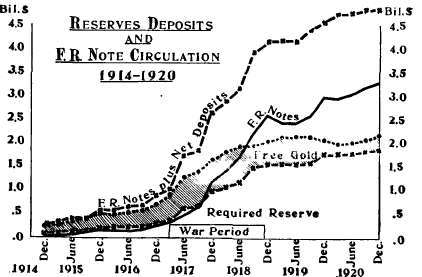
Fig. 4, Chapter 9, shows the growth of the deposits and note circulation of the Federal Reserve banks during the war period, and their continued expansion after the end of the war. This caused the "free gold" (the margin of gold above the legal minimum requirements) to decrease until the middle of 1920. This was getting nearer and nearer to the point where discount rates must legally be raised (in some districts the point was passed), and finally compelled a contraction of credit, which then came quickly and violently.
Little use had as yet been made by member banks of the rediscount privilege, because, as the new legislation had reduced their own reserve requirements, they had "plenty of slack" lending power, which only gradually had begun to be taken up. Nevertheless, all of the Federal Reserve banks, before the end of 1916, had earnings in excess of expenses, and one after the other began to declare dividends and to increase their surpluses, to the surprise of many who had predicted that this would not be possible.
§ 11. Operation in the war period. With our entrance into the war the Federal Reserve system, and our banking institutions altogether, entered upon a growth that has been characterized by the Federal Reserve Board as "in many ways the most remarkable in the financial history of the world." At the beginning of the period the volume of business at the Federal Reserve banks was too limited, while the available resources of member banks were too large to enable the Federal Reserve institutions to exert more than an incidental influence upon credit uses. The period of belligerency changed these conditions, and at its close the Federal Reserve banks stood as the holders of nearly the entire reserves of the country, the directors of the one unexhausted reservoir of banking credit in the world.11 The Federal Reserve system began at once to act as the fiscal agency of the government, and continued throughout the war period and the post-war period, including the fifth (or Victory) loan, to fill the central role in fiscal operations. During this period the net deposits of the system increased 2 1/2-fold, the notes in circulation increased 7-fold, and earning assets increased 14-fold. Paper admissable under the rules for rediscount, especially that based on governmental securities, which were given preferential treatment and rates, increased greatly in amount. Member banks made use extensively of the rediscount privilege, and took the proceeds, either in notes or in credit, to their reserves, this being a source of large earnings for the Federal Reserve banks. The accompanying table shows the net earnings by years:
11 Paraphrased from editorial statement in the "Federal Reserve Bulletin," Dec. 1, 1918, p. 1164.
Fig. 5, Chapter 9, shows the rapid growth of earning assets of the Federal Reserve bank during the war period, from barely more than a tenth of a billion dollars to over two billions at the date of the armistice. Observe that after the war, as the member banks availed themselves freely of the rediscount privilege, the total rediscounts rose rapidly by more than another billion, despite the decrease of war paper. The "other discounts," which meant commercial loans, must be looked upon as in large part the cause of the commercial speculation, "profiteering," and inflated prices, which marked the period from the middle of 1919 to the middle of 1920.
Net Earnings of Federal Reserve System
Net Earnings of Federal Reserve System | |||
Net earnings of capital | Per cent | ||
Nov., 1914, to end of | 1915......... | $516,116 | |
Calendar year | 1916......... | 2.750,999 | 5.0 |
" " | 1917......... | 11,202.992 | 18.9 |
" " | 1918......... | 55,446,979 | 72.6 |
" " | 1919.......... | 82,038,785 | 98.2 |
" " | 1920.......... | 151,408,031 | 160.7 |

Continue to:


My Books

