


23. Division Of Labor. Varieties Of Division Of Labor
Description
This section is from the book "Elementary Economics", by Charles Manfred Thompson. Also available from Amazon: Elementary Economics.
23. Division Of Labor. Varieties Of Division Of Labor
In the early life of a people and on the frontiers of older nations, every man must necessarily be a jack-of-all-trades. He must clear his land, build his fences, construct his cabin and sheds, make his own furniture, tan the leather for his shoes, and perform many other similar tasks, all of which are necessary to his very existence. As population increases, each one gives more and more attention to the trade or profession he is best prepared to follow. Some become carpenters; some, farmers; some, blacksmiths; and some, tanners. The carpenter, for example, spends his whole time engaged in his trade, and he is able to perform all the operations which are necessary in erecting a building. He does the finishing work as well as erect the frame. Moreover, he makes doors, glazes windows, and builds furniture. Likewise the farmer, the blacksmith, and the tanner, each performs all the operations necessary to carry his product from the raw material to the finished state. This stage of industrial development characterized American life and industry for two centuries; and we may call it simple division of labor.
Population of the United States in Municipalities having over 30,000 Inhabitants, in those having from 8,000 to 30,000, and outside such Municipalities: 1790-1912. ,
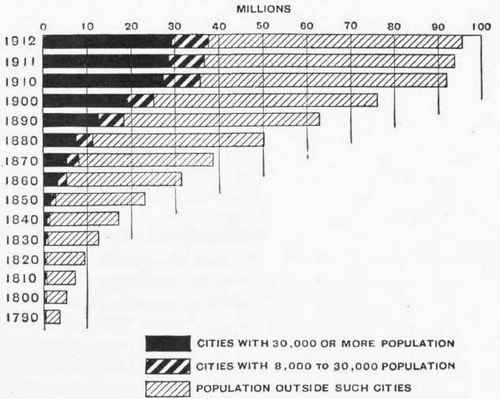
The next step in the development of division of labor consisted in dividing the operations of a single trade among individuals or groups. Instead of the carpenter, we have workmen for the rougher work, others for finishing, others for door and cabinet work, and still others who specialize in glazing. This stage we call the complex division of labor, and we may observe its operation all about us in every craft and profession. Carpenters alone no longer build our houses. To assist them we employ masons, plasterers, plumbers, and electricians. Professional people likewise specialize in narrow fields. Some physicians give their whole time to particular ailments; lawyers become highly trained in particular kinds of work; while teachers confine their attention to as few subjects as possible.
Perhaps the best example in the development of the division of labor is found in the manufacture of shoes. Under pioneer conditions a workman tanned the leather and from it made shoes for himself and family. Later he gave his whole time to making shoes, disposing of the surplus to his neighbors. At the present time the making of shoes is confined almost entirely to factories, where scores of men perform as many different operations in making a single shoe.
The encroachment of the complex division of labor on crafts and trades has had a curious effect. It has, as it were, robbed the craftsman of his skill. Shoemakers no longer make shoes, neither do watchmakers make watches, while a tailor shop is often nothing more than a place for repairing, cleaning, and pressing clothing.
Continue to:


My Books

