


Chapter XVI. Monetary Laws Illustrated From The History Of The United States. 49. Some Important Monetary Laws. The Bimetallic Ratios
Description
This section is from the book "Elementary Economics", by Charles Manfred Thompson. Also available from Amazon: Elementary Economics.
Chapter XVI. Monetary Laws Illustrated From The History Of The United States. 49. Some Important Monetary Laws. The Bimetallic Ratios
Until a comparatively recent period bimetallism prevailed among the more advanced industrial nations - that is, they employed both gold and silver money standards. Each government authorized its mints to manufacture the standard coin in either gold or silver, their relative weights depending on some previously determined ratio, which hereafter we shall call the mint ratio. Obviously, at the same time there was also a market ratio between these metals, just as there is always a market ratio between wheat and corn, which no government can effectively control. Thus, the government could fix one ratio but not the other. Accordingly, the two ratios were seldom the same. An influx of gold into any country tended to cause the value of that metal, as compared with silver, to fall, while an outflow of gold tended to cause its value to rise. In the first case gold was said to be overvalued; in the latter, undervalued. Both terms, as used in discussions on bimetallism, create unnecessary confusion, which any one of us, by exercising a little caution, can avoid. Both terms apply to the value set by the mint. If an oversupply of gold causes, as we have seen, the value of that metal to decline in the markets in terms of silver, then at the mint, where the ratio remains constant, it is obviously overvalued. Similarly, an undersupply of gold causes it to be undervalued at the mint.
To give concreteness to our subject let us assume that a government fixes the mint ratio at 15 to 1, which means that the standard silver coin shall weigh exactly fifteen times as much as the standard gold coin, the two coins having the same fineness and the same legal-tender value. If in the market of that country an ounce of gold will buy twenty ounces of silver, then it is clear that gold is undervalued at the mint; and that silver is overvalued. Conversely, if an ounce of gold exchanges in the market for less than fifteen ounces of silver, fourteen say, then silver is said to be undervalued and gold overvalued. The inability of any government to change its mint ratio to correspond with the daily shifting market ratio accounts in large measure for the difficulties encountered in trying to maintain a bimetallic standard, and for its abandonment, as practically all of the leading countries have done.
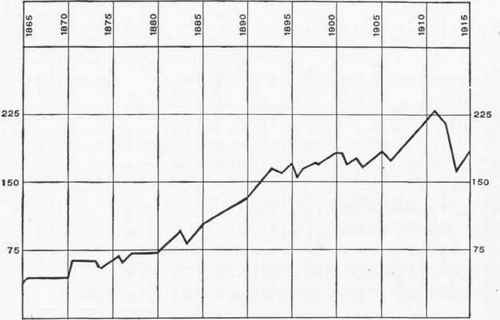
World Production of Silver: 1885-1915 (In Millions of Ounces).
Continue to:


My Books

