


Consumers' Surplus
Description
This section is from the book "Elementary Economics", by Charles Manfred Thompson. Also available from Amazon: Elementary Economics.
Consumers' Surplus
The rectangle F in Fig. 3 represents not only the marginal utility of the six chairs, but also the price paid for each of the six. The total price, therefore, of the six is represented by the rectangle PO. Clearly, then, the purchaser of the six chairs enjoys a greater satisfaction from five of them than he would have enjoyed had he spent his money for other goods, for we may assume that the utility yielded by the sixth chair is measured by the price of each of the six chairs. This excess satisfaction is known as consumers' surplus. In the case of each chair it is the difference between the price paid, represented by the margin, and the price that would have been paid rather than to forego its use.
The principle of the consumers' surplus is the basis of all trade and exchange. In the middle ages the opinion prevailed that only one party to a trade could be benefited. This opinion we now hold to be erroneous. In practically all of our purchases and exchanges, even though we desire but a single unit of any good, we enjoy a consumers' surplus. If such were not the case few exchanges would take place, since each one would prefer his own goods to the goods of another.
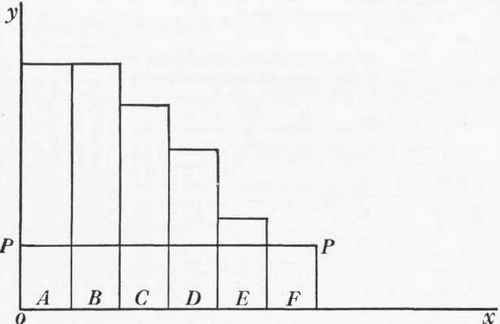
Fig. 3.
Continue to:


My Books

