


Discovery Of The Balance
Description
This section is from the book "Elementary Economics", by Charles Manfred Thompson. Also available from Amazon: Elementary Economics.
Discovery Of The Balance
In the course of time the moneylenders (bankers) made an important discovery. They found that their neighbors (depositors), possessing a variety of "money habits," left a portion of their combined deposits in safe-keeping all of the time; that is, there was a balance, varying in amount from day to day, which the banker might use as if it were his own. With this knowledge in hand the banker employed a portion of the balance in his own business or, as was more often the case, loaned it out to those who had need for money and who could give proper security. Here, it is believed, is the origin of modern banking.
In conducting his business in this manner the banker ran the risk of being unable to meet unexpected demands by his depositors. To forestall such a calamity he had to be on his guard at two points. First, he made loans only for short periods of time and on good security. To use a modern banking term, he kept his funds liquid. Second, he kept a portion of the balance as a reserve, the size of which depended on his experience as a banker and on the margin of risk which he cared to assume. Later, bankers developed a plan of issuing their own promises to pay (bank notes) to borrowers, undertaking to redeem them on demand. Here again they discovered that some of these notes would always be in circulation. Consequently, they kept on hand only enough gold or silver to redeem the notes as they were presented. Naturally the next step which the banker took was to grant business men the right to check on him, each securing the amount of his credit by giving the banker security in the form of a promissory note. From this discussion it may be seen that the banking business is built on confidence, and that without it there would be neither balances nor note issues. The two chief functions of a bank, then, are (1) to receive deposits in the form of money or credit and in turn to lend money on credit, and (2) to issue notes. In this country no bank, strictly speaking, possesses the second function. Its business, therefore, is confined chiefly to the first function, though it may and does perform many minor ones.
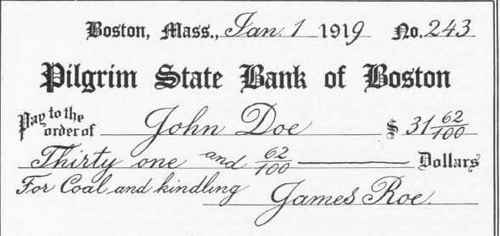
Bank Check.
Continue to:


My Books

