


Government Coinage
Description
This section is from the book "Elementary Economics", by Charles Manfred Thompson. Also available from Amazon: Elementary Economics.
Government Coinage
Very soon after the organization of the first United States Bank, the government provided a bimetallic coinage system (1792) in which the ratio was to be 15 to 1. For many years after its establishment the mint coined comparatively little silver or gold: there were few mines in the country, foreign coins passed current, while the United States banks, as we have seen, provided a sound and uniform currency. In 1834 the mint ratio was changed to 16 to 1. All the while the market ratio was in the neighborhood of 15 1/2 to 1. Hence, the first coinage law (1792) undervalued gold; the second (1834) undervalued silver. Neither law, despite the best efforts of the lawmakers, caused gold and silver to circulate side by side. The holder of either metal - coin or bullion - followed his own economic advantage; he paid out his overvalued coins and sold or exported his undervalued ones. Since the law of 1834 tended to drive silver out of circulation by undervaluing it, the fractional silver coins (half-dollar, quarter-dollar, and dime) disappeared. Consequently, in 1853 the weights of these coins were slightly reduced in order to make them worth more as money than as bullion. Since that time the weights of all our gold and silver coins have remained unchanged. The discovery of gold in California in 1848 gave an impetus to gold coinage. A little later the mints were turning out gold coins in excess of $25,000,000 annually. During this period an impetus was given to the use of gold and silver as money by the government itself, which refused to recharter the second United States Bank (1832), to accept state bank notes in payment for public land (1836), and to use state banks as public depositories (1846). Government paper money. - When the Civil War broke out, the circulating medium of the country comprised gold coins, fractional silver coins, copper coins, and state bank notes. Soon the state banks, as we shall see in the next chapter, were compelled to suspend specie payments - that is, they were no longer able to redeem their notes in gold or silver. At the same time the government itself also suspended specie payments. The result was a serious derangement of the monetary system. Congress then set about to remedy the situation. The secretary of the treasury was authorized (February, 1862) to issue $150,-000,000 in United States notes (greenbacks). Four months later Congress authorized a second issue of the same amount. Subsequent issues brought the total amount up to $450,000,000
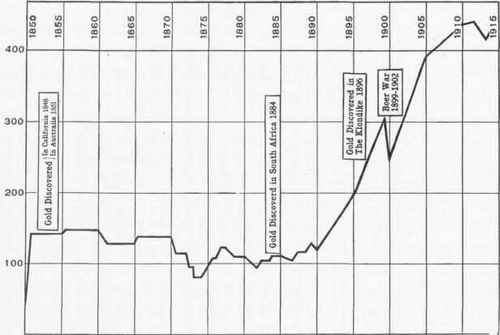
World Production of Gold: 1850-1915 (In Millions of Dollars).
The government had no reserve of gold and silver with which to redeem these notes. Hence we call them irredeemable or inconvertible paper money.
Continue to:


My Books

