


Insurance Against Illness And Old Age
Description
This section is from the book "Elementary Economics", by Charles Manfred Thompson. Also available from Amazon: Elementary Economics.
Insurance Against Illness And Old Age
The German plan of insuring against illness was instituted in 1883. There the state requires each employer to purchase weekly from the post office, insurance stamps for each of his employees. At least one-third of the cost of the stamps must be contributed by the employer, who may, if he chooses, deduct the other two-thirds from his employees' wages. Should an employee become ill he has his stamps, which are fastened to insurance cards, as evidence that he is insured. The provisions of the German law cover many different aspects of illness. (1) Naturally the first provision is for free medical attention. In case of serious accidents, such as the loss of a leg or an arm, the state supplies artificial limbs. (2) Free hospital service is also furnished where necessary, and special attention is given to hospitals for young mothers and babies. (3) One-half of the wages of an ill workman are paid for a maximum period of six months. (4) Finally, small benefits are paid to the dependents of deceased employees. Germany provides also for compulsory insurance against the hazards of old age. As in the case of illness employers must affix stamps to insurance cards, being permitted to withhold at most one-half of the amount from employees' wages. The buying of stamps begins for each employee at the age of sixteen. Benefits are first paid at the age of seventy, or earlier to those who are totally incapacitated for labor. Both the premiums on the insurance and the benefits paid to the insured are relatively small. The first average only a few cents each week (3 1/2 to 9) while the latter average approximately one dollar a week.
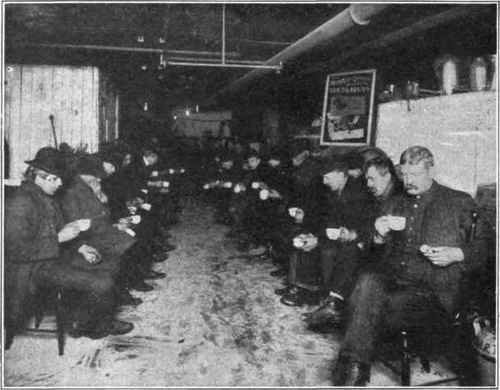
Copyright International Film Service, New York.
Feeding the Unfortunate.
Here we see homeless men being fed at public expense.
Great Britain has also provided insurance against illness (1912) and old age (1908). In each case the British law is similar to that of Germany. British employers must purchase illness insurance stamps for their employees, the two groups sharing about half and half in their cost. The benefits resemble the benefits under the German system, the chief features being free medicine, free hospital service, and weekly sick benefits ($2.50 for men and $1.75 for women). Under the British old-age pension law any wage-earner of that country, when he reaches the age of 70, is entitled to a small pension if he can prove that he has lived in Great Britain during the past twenty-six years and does not already have an annual income exceeding about $150.
Continue to:


My Books

