


The Silver Question
Description
This section is from the book "Elementary Economics", by Charles Manfred Thompson. Also available from Amazon: Elementary Economics.
The Silver Question
Two years prior to the passage of the resumption act, the government, in revising its coinage laws, omitted any mention of the standard silver dollar. In other words, the law demonetized silver. This legislation is usually referred to as the "crime of '73." At that time the market value of the 371.25 grains of fine silver necessary to coin a dollar was about $1.003 in gold. Hence no one was willing to carry silver bullion to the mint, for by so doing he would be compelled to exchange S1.003 for $1.00. It happened, however, that just about this time a great many rich silver mines were opened in the western part of the United States. Consequently, the value of silver fell until its market value was less than the old mint value - it fell to a point where it required more than 16 ounces of silver to buy one ounce of gold. Then the silver miners and their friends demanded that the government go back to a bimetallic basis. This a majority in Congress was unwilling to do. The matter was finally compromised in 1878 with the enactment of the Bland-Allison Law, which provided that the secretary of the treasury should purchase each month from two to four million dollars' worth of silver, paying silver certificates for it. Silver production continued to increase. In 1890 another law, known as the Sherman Act, was passed. It required the secretary of the treasury to purchase four and one-half million ounces monthly, and to issue in payment treasury notes redeemable in gold. This new strain was too much for the gold reserve, for Holders of silver bullion after accepting the treasury notes were privileged to present them forthwith for redemption.
Market Value of the Silver Dollar in Terms of Gold: 1865-1918.
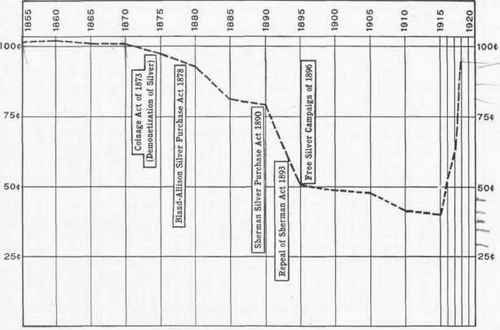
The government was now at a point where it had to meet the silver question squarely and without flinching. In 1893, at the instigation of President Cleveland, Congress repealed the Sherman Act. This was the signal for the friends of bimetallism to make silyer more of a political issue than ever before. Three years later the Democrats, led by William J. Bryan, made free silver their paramount issue. They pledged themselves, if returned to power, to remonetize silver, making it equal to gold at a ratio of 16 to 1. The Republicans declared for a single gold standard. Each party was divided over the issue. The "Gold Democrats "nominated a ticket of their own, while many western Republicans supported Mr. Bryan. The Republicans carried the day, their candidate, William McKinley of Ohio, being elected president. Four years later (1900) the so-called gold-standard act was passed, which provided definitely that the monetary standard of the United States should be the gold dollar of 25.8 grains, nine-tenths fine.
The experiences of the United States in its monetary legislation has been paralleled in every other modern nation. Every one of them has experienced the same difficulties, particularly in trying to maintain a bimetallic standard. England was the first to adopt the single gold standard (1816). Other European nations held back. Finally one by one they had to abandon their attempts to keep gold and silver at a fixed ratio, until now every country of any great importance is on a gold basis.
Continue to:


My Books

