


The Unearned Increment
Description
This section is from the book "Elementary Economics", by Charles Manfred Thompson. Also available from Amazon: Elementary Economics.
The Unearned Increment
Closely associated with economic rent is what is commonly called the unearned increment, which means the added value given to land by society and not by landowners as such. For the sake of clearness we may confine our attention to urban sites, for it is there that social forces have had the greatest influence in raising land values.
Our discussion of urban rents has paved the way for the statement that retail-store sites are determined largely by the habits of the consuming public. One block is better than another for certain kinds of retailing. Just why it is better is a matter to be determined in every individual case: perhaps it is the location of the courthouse, or of the post office, or of a popular theater. Whatever the reasons - important as they are in actual business practices - we need only to remember that equal-sized business sites produce unequal amounts of economic rent, and that these inequalities rest largely on forces usually independent of the owners of the sites. Twenty years ago, to cite an example, an eastern capitalist acquired a vacant business lot in the city of Denver for $10,000. In the meantime his taxes and loss of interest on his investment totaled $17,000. Recently he sold the lot for $100,000, realizing over and above its entire cost to him the sum of $73,000. Not once in the twenty years did the capitalist visit Denver. Nor was it owing to any influence of his that the city grew, and that the people there acquired the habit of passing his vacant lot in great numbers. Yet without effort, and even without any show of foresight, for he had reluctantly taken the lot on an old debt, he gained a small fortune. As one of his friends expressed it, he reaped where he did not sow. Single-taxers argue that all such increases in value should go to society and not to individuals. These arguments are best expressed by the single-taxers themselves in a well-known pamphlet entitled A Single-
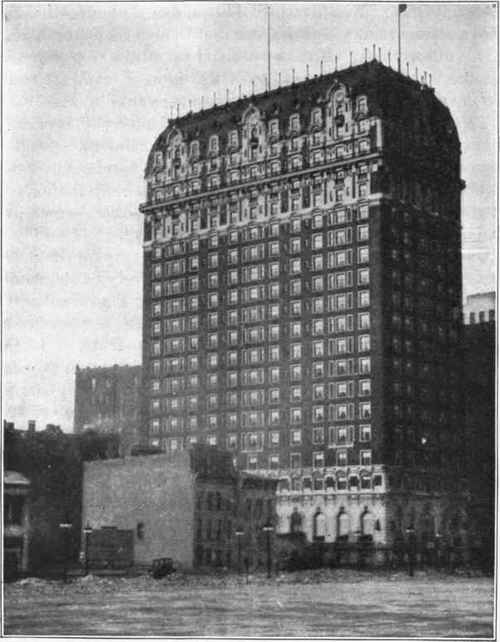
Different Utilization of Similar Pieces of Land. How did the erection of this hotel affect the value of adjacent sites ?
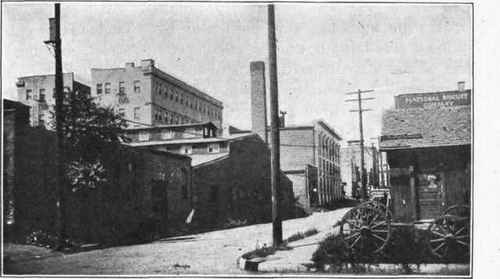
No Man's Land.
In almost every city is to be found a fringe of sites around the business center undesirable either for stores or for residences.
Tax Catechism. The following three questions and answers indicate the nature of the catechism:
Q. What is meant by the Single Tax?
A. The payment of all public expenses from ground rent, the normal revenue, thus eventually abolishing all taxes.
Q. What is the ethical basis of the Single Tax?
A. The common right of all citizens to profit by site values of land which are a creation of the community.
Q. What is meant by the site value of land?
A. The market value of situation irrespective of improvements.
Any discussion of the unearned increment is incomplete without some mention of a contrary movement known as the unearned decrement. This concept can best be explained by reference to another concrete example. Several years ago a group of men built an apartment house in the city of Chicago on land then valued at $30,000. At that time the neighborhood was one of the best in the city. Shortly afterward several small store buildings were built near by. Then the elevated railroad was built down the middle of the street, and finally one of the large department stores built a warehouse on an adjoining lot. Desirable tenants could no longer be secured. The apartments were necessarily let to lower-income classes. The result was that the value of the ground declined from $30,000 to $15,000. Here was a loss inflicted on a small group of individuals by other individuals and by society at large. While no one believes that in the typical American city the decrement equals the increment, the fact must not be forgotten that a portion of the increment is offset by a decrement.
Continue to:


My Books

