


Wants And Social Progress
Description
This section is from the book "Elementary Economics", by Charles Manfred Thompson. Also available from Amazon: Elementary Economics.
Wants And Social Progress
The very fact that wants are incapable of being satisfied has led to our present state of civilization. Any individual or social group, such as a people or a nation, that has all of its wants satisfied, is in danger of decay, if indeed it has already passed beyond the stage of savagery. Many good causes have been assigned for the lack of social and industrial progress among the American Indians, the best of which is that they did not have wants sufficiently varied and intense to compel them to give up their roaming life and to make a start in permanent agriculture - in other words, to go to work. The same influence partially explains the differences in the social and industrial developments among various peoples. The inhabitants of tropical and subtropical regions are notoriously unprogressive. They feel no need for permanent shelter and warm clothing, and even the getting of sufficient food is a simple matter. Granted that the warm climate dampens their enthusiasm for work, the significant fact remains that the kindness of nature in supplying their primitive wants robs them of their best energies. Very cold climates, on the other hand, compel so much labor to provide bare necessities as to leave little time for supplying higher wants. It is, therefore, in the temperate regions where we find the highest development of civilization. There nature is neither too liberal nor too exacting. There men, though they must supply their primitive wants by labor, have a sufficient surplus of time and energy left to supply their wants for higher things.
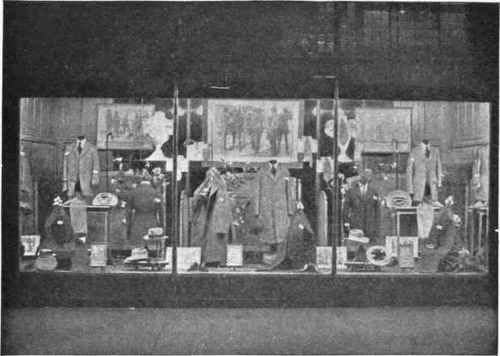
Courtesy of Hart, Schaffner & Marx, Chicago, Ill.
Window Display of a Specialty Store. (Contrast with display on opposite page.)

Courtesy of S. S. Kresge Co. Chicago, Ill
Window Display of a Variety Store. (Contrast with display on opposite page.)
On the ground that an increase in wants produces social progress we find one of the chief justifications for much of modern advertising. There are some who contend that advertising merely results in changing the demand either from one kind of a good to another or from one good to a similar good merely of a different make and brand; in other words, that advertising is largely a social waste. Such a contention is certainly sound to a degree, but above and beyond is the influence which advertising has on stimulating individuals to greater endeavors through an increase in the intensities of their wants.
Continue to:


My Books

