


Chapter 19. Saving And Production As Affected By The Rate Of Interest. Sec. I. Saving As Affected By The Interest Rate
Description
This section is from the book "The Principles Of Economics With Applications To Practical Problems", by Frank A. Fetter. Also available from Amazon: The Principles of Economics, With Applications to Practical Problem.
Chapter 19. Saving And Production As Affected By The Rate Of Interest. Sec. I. Saving As Affected By The Interest Rate
1. In the case of consumption goods, present marginal uses are often less than future uses as judged at the present. The proposition that future goods sometimes have a greater instead of a less value than present goods may at first seem to deny the general fact of economic interest, which is a premium on present over future goods. The contradiction is only apparent, however, and the proposition is merely a proper interpretation of the theory of interest. The assertion that present goods have greater value than future goods, as we have accepted it, requires two explanations. First, it means that this difference exists when the two are judged and compared at the present moment. The future use when it matures may be much greater than the present use; indeed, the very existence of interest depends upon this surplus of value arising by the lapse of time in the future use. Secondly, the proposition does not mean that every concrete good, or every use of the goods, is worth more in the present than in the future; it means merely that the demand for present goods preponderates so that a market rate in favor of present possession prevails. In a great many cases a particular good may have a greater value to be kept for the future than to be used at present, in which case it is kept, or it is exchanged for something else having a higher value in the present. But this preference of the future over the present cannot pass a moderate limit without condemning the person to present misery, and at length to death. On the other hand the excessive preference of present over future would lead to the using up and wearing out of wealth, to the present enjoyment of every possible resource, on the penalty of future misery. Evidently somewhere between these two extremes there must be, in each economy, a ratio of exchange between present and future, which in fact is the interest rate. This rate applied to utilities traces through each good a line analagous to the isothermal line on the map, marking off a zone of utilities for the present and other zones for each period of the future. There is thus a close relation between saving and the rate of time-discount.
The interest rate traces the division between present and future gratifications.
The less necessary goods are the ones saved.
Let us illustrate by the case of fruit stored in the cellar for future use. In the fall after the appetite for apples has been gratified up to a certain point, there still remains a large stock which affords less gratification if consumed at once than if kept for a time. Thus wood, food, and clothing are stored in the summer for the winter's need. Even the animals act on this principle. Squirrels, bees, and ants store up in the season of superfluity for the season of scarcity. The animals recognize with their feeble intelligence or by instinct, that a time will come when these consumption goods will represent greater importance to their welfare than they do at the moment. It results from the nature of wants and the principle of diminishing utility that in many cases some portion of a large supply of present goods must be worth less now than at a future time. This part, the marginal, less necessary part, will be left for a future time, and it is to this part that our opening proposition refers. This is roughly illustrated by the diagram.
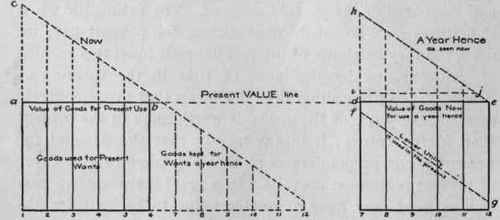
Things that cannot be kept, perishable goods, do not permit of this comparison. But if goods that can be kept continue to be used after utility has fallen down the scale, their high value for the future is cast away. Man lives not alone in the present but, in a far greater measure than do any animals, he lives in the future also. His economic life and his economic judgment comprehend a great number of periods at once. With the aid of memory and imagination he forecasts the future, and compares it with the present. The diminishing utility of goods, therefore, is modified by this fact that a thing has want-gratifying power at different periods. Before man uses goods for an inferior purpose he will ask whether, if they are kept for the future, they will not gratify a greater want.
2. The gradual rise of a consumption good with the lapse of time from the lower to the higher degree of gratification is the rent it yields. The difference in value of present and future rents is expressed by the discount of the future use when it is capitalized at any earlier moment, and emerges in the rise in value as the thing approaches to the time when it can render the later use. Next year the unit whose use is deferred will afford as much gratification as the earlier units do now, and more than if used at the present moment. The importance of any present utility is compared with its importance a year later, plus interest at a rate which expresses the limit to which future uses are discounted. Anything that makes men feel more the importance of future uses causes them to value those uses more. But the pressure of present want is such that a present use of a lower order competes with a future use of a higher order. Only goods of a lower order, nearer the margin, are reserved for the future. But just as the possibility of using a thing for several different purposes at present causes it to be valued more highly than if it had but one use, so the possibility of reserving to the future a portion of a stock imparts to every unit a higher marginal utility.
The less valuable rise in value with the lapse of time.
Interest is the equalizer of time values.
3. The saving of present goods for future use is encouraged by the motive of gaining the interest. Many consumption goods grow into higher uses in the hands of the owner, whether he uses them for himself or not. Ice may be stored in midwinter when it is all but a free good and a little labor serves to fill the ice-house. Kept until the summer months, the ice rises in value as the desire for it grows. Likewise the higher price secured by the owner of a thing kept for sale to others, reflects the change in utility, and affords practically a rent which is the motive for investing capital in that business. Any saver or abstainer puts aside present wants only when the future good, with the addition of time-value or of money interest, appears as large as the present good. Interest is therefore the equalizer of the value of things in different periods. Put into the scale of judgment when present and future are compared, it helps to balance the disparity in the gratifications given by economic goods in different periods of time.
Saving increases and improves economic agents.
4. The postponement of present wants results in bettering the economic environment for the future. Economic environment means simply the economic conditions in which men live, the stock of wealth, the supply of useful things with which they are surrounded. This betterment may be only temporary, only for the immediate future. Like the busy bee or the prudent ant, one may in summer store the cellar with consumption goods to be consumed the following winter. But often there is a more lasting way of improving the economic environment by converting savings into durable indirect agents. The accumulation of wealth that will yield its fruits only after years of growth is the record, so to speak, of the successful competition of forethought with present desires. It means that the two periods have presented their respective claims and that men have decided in favor of the future. Saving thus lifts society from poverty to wealth by the progressive enlargement of the sources of future utilities.
5. Abstinence is the faculty of mind that enables present wants to be subordinated to future wants. Abstinence may be considered as a quality, or faculty, of the mind, or as an act resulting from that quality. There is little danger of confusion in this usage, but it is well to note the distinction and the fact that the former is the primary meaning. Abstinence expresses an act of the will, a choice made by man. It is the guardian of the future, so to speak, against the greediness of the present. For convenience we may speak of conservative abstinence as that which keeps men from using up or invading their present stock of resources, and of cumulative abstinence as that which impels them to add to that stock. There is no sharp dividing line, no abrupt break, between these two, yet on the whole they differ. There is a quality of mind very like the inertia or momentum of physical matter. The inertia of mind makes men resist stubbornly the reduction of wealth and of inherited social position ; but it requires a more positive quality of mind to add to wealth at the cost of present sacrifice. Abstinence is embodied in individuals, never elsewhere, and is found in most varying degrees of strength. Upon it depends the growth and betterment of man's environment.
The kinds of abstinence.
Continue to:


My Books

