


Some Seasonal Price-Variations In Food
Description
This section is from the "Source Book In Economics" book, by F. A. Fetter. Amazon: The Principles Of Economics.
Some Seasonal Price-Variations In Food
[The seasonal variation in the production of some farm products and the corresponding changes in prices have been studied by H. C. Taylor and published in Bulletin 209 of the University of Wisconsin Agricultural Experiment Station (May, 1911). By the courtesy of Professor Taylor we are able to reproduce with the diagrams the following passages. The facts here given illustrate interestingly the nature and limits of elasticity of demand for these articles, the problem of time-value in perishable foods, and the influence of cold-storage in equalizing prices throughout the year.]
Eggs; irregularity of supply. The egg market lends itself well to the study of many of the forces which influence prices. Irregularity of the supply, variation in the quality of the product, and a highly elastic demand are characteristics strongly accentuated in the egg market. The monthly distribution of the average annual production of eggs on a Wisconsin dairy farm is shown in figure 1. The chart shows the percentage of the year's egg production gathered in each month in the year for five years. March and April were the months of greatest productions. The production fell off greatly during the summer months and reached its lowest level during the winter months.
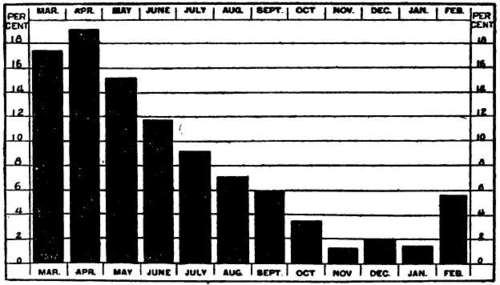
Figure 1. Production of eggs on a Wisconsin farm; percentages of the annual total by months, five-year average.
It is believed that this chart tells fairly well the story of the irregularity of egg production on farms where the keeping of poultry is primarily for supplying the wants of the household, and the sale of eggs more or less incidental.
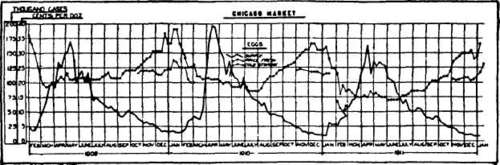
Figure 2. Weekly receipts and prices of "prime first" class eggs in the Chicago market, Feb. 1, 1909 to March 20, 1911.
It is possible for the poultryman to control the egg production in such a manner as to secure a much larger proportion of the annual product in the winter months, but the bulk of the egg supply is not produced under these conditions. . . . Egg production is a widely disseminated non-specialized industry and the supply is not likely to be appreciably influenced by the conscious action of a few individuals.
The Chicago egg market. The supply of eggs upon the Chicago market corresponds to these conditions of production. In Figure 2 the solid black line represents the weekly supply of eggs brought to Chicago, from February 1, 1909, to March 20, 1911. The supply of eggs reached the maximum in April and May and gradually fell off until the end of the year.
The price of eggs on the Chicago market shows the influence of the irregular supply. The black dots connected by lines, in Figure 2, show the price of the best grade of eggs for one day in each week.
The relation between the supply curve and the price curve in this chart illustrates the influence of variation in the supply upon the price of this perishable commodity. The fact that the price of eggs in Chicago remained above 20 cents during the periods of greatest receipts in 1909 and 1910 calls for some explanation. The elastic character of the demand for eggs has already been mentioned. At a price between 20 and 25 cents eggs become an inexpensive substitute for meat, and at the time of the year under consideration, weather conditions are usually such that eggs can be put upon the market in good condition. Under these circumstances the consumption of eggs expands enormously.
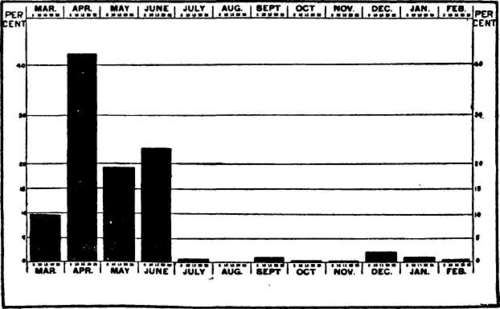
Figure 3. Storage of eggs by a Chicago firm; by months, in percentages of total annual storage.
The storage of eggs. The market is not entirely dependent, however, at the period of maximum supply upon the demand for eggs for immediate consumption. At that period many eggs are purchased and put in storage for use during the period of scarcity of fresh eggs. The time of year when eggs are put in storage by one Chicago firm is shown in Figure 3. Without question this speculative buying steadies the price during the spring months of excessive supply, distributes the consumption more evenly through the year, and secures for the producers a higher return for their eggs than could be secured without storage.
The stored egg is much less valuable in winter than is the fresh supply. The lower price curve shown for a few winter months in Figure 2 shows the prices of refrigerator eggs. It will be noted that there was often a difference of 10 cents per dozen between the price of fresh and of stored eggs. It should also be noted that the price at which the refrigerator eggs were sold was not very much higher than the price at which they were purchased. There must, in the long run, be enough difference to pay the actual costs of storage including rent for the warehouse, losses due to deterioration, interest on the money invested, insurance, and enough profit to induce a business man to give his attention to this business instead of doing something else.
The thing of first importance both to producer and to consumer is an understanding of the proper methods of handling eggs, proper methods on the farms, in the country stores, in transit, in cold storage, in the shop of the city retailer and in the homes of the consumers. Success in holding a part of the eggs of the surplus season to meet the demands of the deficit season is dependent upon proper handling at every point. It is safe to say that more bad eggs reach the kitchens of America from other causes than from too great a length of time in cold storage. Furthermore, many eggs that reach the kitchen in good condition are allowed to deteriorate in a warm room before the cook finds occasion to make use of them. There is responsibility all along the line. Failure at any one point spoils the egg.
The testimony before the Senate Committee relative to foods held in cold storage was to the effect that eggs produced during hot weather will not, even under most favorable conditions, remain fit for use over three months, and that more often in less than a month they are unfit for human food. This is reason for not storing eggs more than temporarily during the hot months, but it does not give basis for legislation against the storage of eggs in the cool months of spring to be kept over until the period of scarcity.
The risk is great in the storage of eggs, because of the fact that the whole supply must be gotten rid of before the increase in the supply of fresh eggs, or they may become almost a total loss. Note in Figure 2 how the price of refrigerator eggs fell, in February, below the price which had been paid for them and then quotations ceased. This speculative feature is accentuated by the fact that the period of greatest scarcity is followed so closely and so abruptly by the period of maximum supply, and by the uncertainty of the time of this change owing to the influence of the weather.
Another aspect of the storage of eggs worthy of consideration is the relatively long time between the surplus period and the period of scarcity. Vegetables may be stored late in the fall for winter use, but eggs must be stored early in the spring and kept through all the hot months. . . .
The supply and the price of butter. The relation of the supply to the price of butter on the Chicago market is shown by Figure 4. The weekly supply is shown to range from fifteen thousand to more than one hundred thousand tubs per week. The months of June and July show the greatest supply while the winter months show a scarcity of butter coming into Chicago.
June and July are the natural months for storing butter. From November to February is the period of short supply and high prices. See figure 5. In order to utilize cold storage as a means of equalizing the supply retailed to consumers, a maximum period of eight or nine months is none too long. The demand for butter is relatively stable. Butter is consumed from day to day with a high degree of regularity. To meet the demand butter must be produced in fairly even quantities each month in the year or the surplus of one season must be stored to meet the shortage of another. In the one case more feed must be produced and stored for purposes of winter dairying. In the other the cows may be allowed to graze while producing the maximum supply of milk. The cost of milk and butter is much lower where grazing is a large factor in the food basis of the dairy herd.
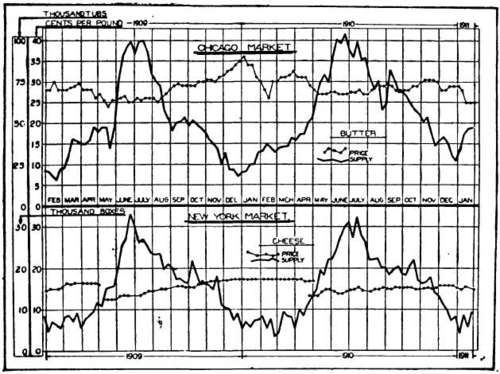
Figure 4 (upper part). Butter, receipts and prices, Chicago market; (lower part) Cheese, receipts and prices, New York market; Feb. 1909 to Jan. 1911.
If butter can be stored successfully, there can be little question as to the economic gain resulting from its storage. If there is any doubt as to the successful keeping of butter in cold storage, great effort should be expended in the solution of this problem, rather than to abolish the storage of butter during June and July for consumption in the winter months. This is a matter of great moment to the butter producers of Wisconsin. Without cold storage our dairy industry would have to be reorganized. With the present system of storing the surplus, the price of butter as shown in Figure 4, holds steady at a fair price during June and July. Without cold storage the supply would have to be reduced during that period, or the bottom would go out of the market.

Figure 5. Cold storage of butter, by months, by one Chicago firm, in percentages of total annual storage.
Any influence which retards the storing of butter during the natural season of surplus production will increase the price of butter during the winter months and give greater advantage to the manufacture of butter substitutes. Some of the raw material for the manufacture of butter substitutes are more abundant in the winter than in the summer months. Butter substitutes are made of farm products. To discriminate against them is to damage one class of farmers for the benefit of another class. The substitute, however, should never be sold for butter. This much the dairyman has every right to insist upon. The butter substitute should be sold for exactly what it is with its constituents marked on the label. The butter substitute will continue to be a strong competitor of the inferior grades of butter and may result in a wider range in prices between first-class and the inferior grades of butter than would otherwise exist. There is little competition between first-grade butter and the substitute. The result may be that the producers of low-grade butter will have to improve their methods or change their occupation. In the long run this will be a good thing both for the producer and the consumer.
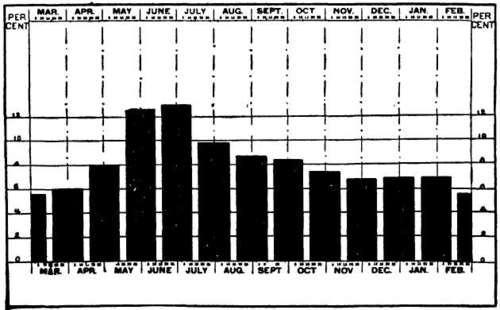
Figure 6. Milk brought to the Wisconsin University creamery, by months, in percentages of total annual quantity, three-year average.
The supply and price of cheese. The price of cheese shows but little variation during the different seasons of the year. The supply, however, is produced in the summer months, and the bulk of it reaches the market during the summer and fall. Figure 4 shows the receipts and the price of cheese on the New York market for two years. One characteristic of cheese is that it improves with age and hence the price of the stored product is higher than that of the fresh supply. This is illustrated in the chart where there are two sets of price dots, in April, 1910, the upper being quotations for old cheese, the lower for new. Contrast this with the situation on the egg market where the reverse is true. (Figure 2-).
Continue to:


My Books

