


Chapter XXIV. Operations On Other Exchanges. Produce Exchanges
Description
This section is from the "Investment And Speculation" book, by Louis Guenther. Also see Amazon: Investment And Speculation.
Chapter XXIV. Operations On Other Exchanges. Produce Exchanges
We have already noted that exchanges are associations of traders, leagued together for mutual protection by rules of their own making. They organize their own market and have jurisdiction over the membership, commodities dealt in, inspection, contracts, finances, etc., of their exchanges.
This same principle has been applied to the marketing of raw materials such as wheat, cotton, tobacco, and live stock. Such exchanges are known as produce exchanges, and are of two kinds, general and special. A general exchange deals in a variety of commodities, such as grain, flour, and dairy products. The Board of Trade of Chicago is a good illustration of a general exchange. A special exchange deals only in one article such as cotton, tobacco, or coffee. The Cotton Exchange of New York City is a good example of this class.
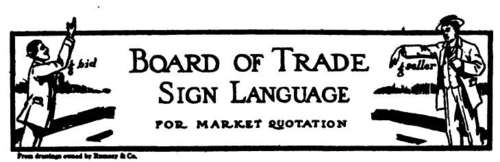
Produce exchanges are distinguished from stock exchanges only in the character of their trading; the general organization is the same. Some questions of administration, however, differ from those of the stock exchange. The rates of commission vary with the character of each commodity dealt with; for instance, the rate on grain may be one-eighth of a cent per bushel, on the Chicago Board of Trade to facilitated by a language of signa and signals peculiar to this institution and perhaps unlikc those, used on the floor of any other Exchange in the world. To the casual visitor watching the crowds congregated about the different pits daring the times of a flurry in prices these suras have no intelligible meaning; but to the experienced trade a simple movement of the hand attracts attention and at the same time conveys all the information necessary to con-snmmate a trade. This language has developed with the growth of the Board and its use has long since become a necessity. Because of the turmoil and the burly burly occasioned by the large numbers seeking to attract attention in the excitement of the hour, which, when accompanied by the dick of hundreds of high keyed telegraph instruments and the scurrying hither and thither of an innumerable number of messengers and errand boys, makes articulate speech almost inaudible and impossible. Then, too, the eyes is quicker than the ear, and (be signals given with the hand or by a gesture of the head means as much as a, telegram to the party addressed and oftentimes permits the dosing of a trade when, if time had been taken in an attempt to reach the side of the party making an offer, some change might have taken place in the market and the opportune moment would have been lost.
Buying And Selling.
The sign-manual of the pit trader to simplicity itself, and with a very little practice anyone can become adept at it; but that to not to say that it will perfect him at a master in the strategy and generalship demanded of a good broker. For instance, wheat having sold at 90 cents, a trader catches the eye of some one opposite in the. pit who has 50,000 bushels to sell, and partly by telepathy, partly by a motion of the clenched fist, signals that he will take the "50 wheat" at 90. The seller, in reply, holds up his right hand with the index finger extended horizontally, indicating that be wants 90½ cents. The buyer motions acceptance and signals back "½.". The two traders note on their cards "Sold 50 at ½ Jones" and "Bot 50 at ½ Smith." After they leave the pit they meet and check the operation.

Fig. 9. Sign Language Used by Traders on the Chicago Board of Trade.
The band being held horizontally, the clenched fist indicates the price in even cents. Each finger represents an added eighth of a cent up to five eighths; the extended hand with the fingers close together means three-quarters, and the thumb only signals seven-eighths. But the whole hand displayed vertically means 25,000 bushels, each finger counting 5,000 bushels; whether offered or being bid for, is shown by a slight motion of the hand to or from the trader making the signal. The official reporter stationed in each pit sees all the signalling, and partly by observation and partly on information given him by the traders, notes the latest price and gives it to a telegraph operator at his side to be "put on the ticker." Thus the price of grain is made every moment of the session and transmitted to all the markets of the world while that on short ribs may be 12½ cents per thousand pounds. The schedules of rates on different commodities differ considerably.
Another matter in which there are differences is the inspection of the commodities dealt in on the exchange. This inspection corresponds in a manner to the listing of securities upon the stock exchange, but is far more complicated. The object is to separate the various commodities into grades, and in some instances the principal grades are again divided into subgrades. The purpose of these grades is to establish a definite contract grade on the basis of which trades for the future may be made. Some commodities, such as tobacco, flour, and live stock, have an individual value which makes it almost impossible to fix a contract grade upon them. They must in most cases be bought upon personal inspection upon a "spot" market.
Two methods of operating prevail upon the floors of the stock exchanges. One is by sample trading and the other by contract trading. The floor of an exchange is usually divided into two parts, the sample room and the pit. In the sample room are displayed samples of the various commodities and trading there is accomplished by personal inspection of the various commodities.
Contract trading takes place in the pit in much the same manner as securities are traded in upon the stock exchange. These transactions are on future contracts and for future delivery. Warehouse receipts are passed between traders instead of actual commodities. If an operator buys a certain number of bushels of wheat he does so with the understanding that he will accept and settle for what he has bought on or before delivery day when the wheat must be tendered him; vice versa, he agrees to deliver the wheat if he is the seller.
All deliveries must be made on the last day of the month, when all settlements also are made, and if the operator is unable to meet his contracts, it is at once a confession of insolvency and his contracts are bought in for his account on the same basis of settlement as on the stock exchange.
In the grain quotations in the daily press, it is to be noticed that the grain concerned in the trading is designated by different months. This implies that all sales and purchases are for the wheat or other coarser grains, which must be settled for on the last day of the designated month. Figures 9 to 13 illustrate some of the operations on the Chicago Board of Trade.
Continue to:


My Books

