


122. Hyacinthus Racemosus. Starch Hyacinth.
Description
This section is from the book "The Botanical Magazine; Or, Flower-Garden Displayed", by William Curtis. Also available from Amazon: The Botanical Magazine; or, Flower-Garden Displayed, Volume I.
122. Hyacinthus Racemosus. Starch Hyacinth.
Hyacinthus Racemosus. Starch Hyacinth.
Class and Order:
Hexandria Monogynia.
Generic Character:
Corolla campanulata: pori 3 melliferi germinis.
Specific Character and Synonyms:
HYACINTHUS racemosus corollis ovatis, summis sessilibus, foliis laxis. Linn. Syst. Veg. ed. 14. Murr. p. 336. Sp. Pl. 455.
HYACINTHUS racemosus caeruleus minor juncifolius. Bauh. Pin. p. 43.
HYACINTHUS botryodes 1. Car Clus. Hist. p. 181.
HYACINTHUS racemosus. Dodon. Pempt. p. 217.
HYACINTHUS botroides minor caeruleus obscurus. The darke blew Grape-flower. Park. Par. p. 114.
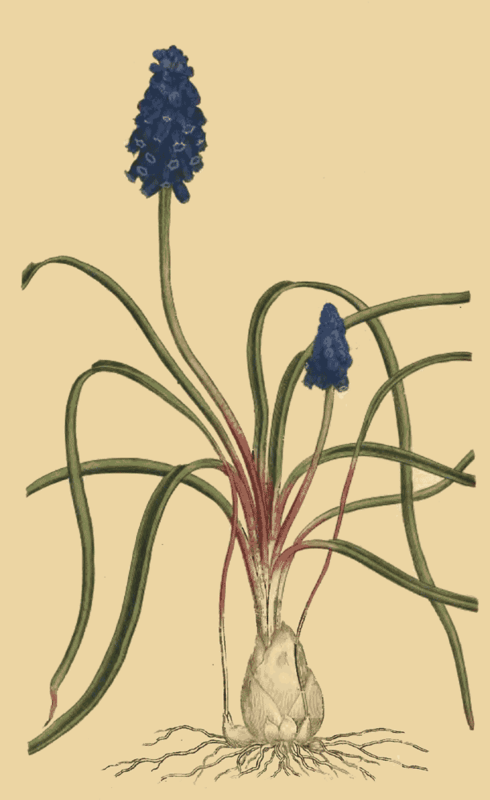
No. 122
The Hyacinthus racemosus and botryoides are both cultivated in gardens, but the former here figured is by far the most common; racemosus and botryoides, though different words, are expressive of the same meaning, the former being derived from the Latin term racemus, the latter from the Greek one βοτρυϛ, both of which signify a bunch of grapes, the form of which the inflorescence of these plants somewhat resembles, and hence they have both been called Grape Hyacinths, but as confusion thereby arises, we have thought it better to call this species the Starch Hyacinth, the smell of the flower in the general opinion resembling that substance, and leave the name of Grape Hyacinth for the botryoides.
The Hyacinthus racemosus grows wild in the corn fields of Germany, in which it increases so fast by offsets from the root as to prove a very troublesome weed, and on this account it must be cautiously introduced into gardens.
It flowers in April and May.
We have found the Nurserymen very apt to mistake it for the botryoides, a figure of which it is our intention to give in some future number.
Continue to:


My Books

