


125. Alstroemeria Ligtu. Striped-Flowered Alstroemeria.
Description
This section is from the book "The Botanical Magazine; Or, Flower-Garden Displayed", by William Curtis. Also available from Amazon: The Botanical Magazine; or, Flower-Garden Displayed, Volume I.
125. Alstroemeria Ligtu. Striped-Flowered Alstroemeria.
Alstroemeria Ligtu. Striped-Flowered Alstroemeria.
Class and Order:
Hexandria Monogynia.
Generic Character:
Corolla 6-petala, sub-bilabiata: petalis 2 inferioribus basi tubulosis. Stamina declinata.
Specific Character and Synonyms:
Alstroemeria Ligtu caule erecto, foliis spathulato-oblongis, pedunculis umbellae involucro longioribus, corolla bilabiata. Linn. Syst. Veget. ed. 14. Murr. Suppl. p. 207. Amoen. Acad. V. 6. p. 247.
Hemerocallis floribus purpurascentibus striatis. Few. Peruv. 2. p. 710. t. 4.
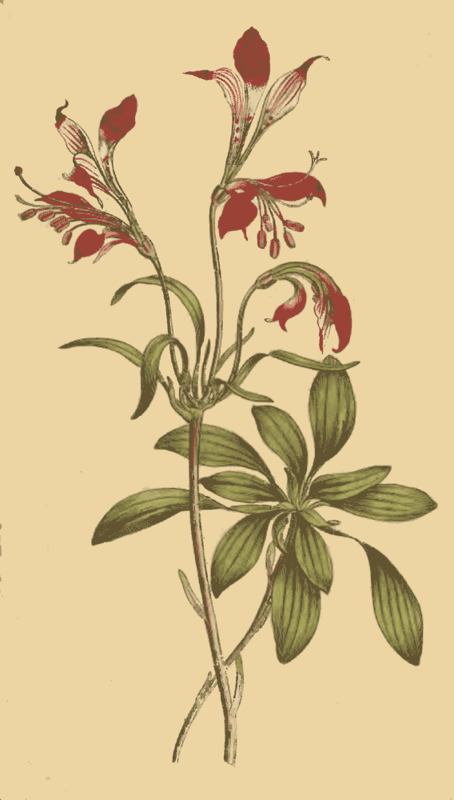
No. 125
This plant receives its generic name from Claudius Alstroemer (son of Sir Jonas Alstroemer, a most respectable Swedish Merchant) who first found the other most beautiful species the Pelegrina in Spain, whither it had been transmitted from Peru; its trivial name Ligtu is a provincial one.
According to Fewillee, who has written on the plants of Peru, this species is found on the banks of the rivers in Chili: we treat it, and successfully, as a stove plant; its flowers, which usually make their appearance in February and March, emit a fragrance scarcely inferior to Mignonet; its leaves, contrary to most others, grow inverted, which is effected by a twist of the footstalk, and afford an excellent example of Linnaeus's Folium resupinatum; the filaments, after the pollen is discharged, turn upwards, and the antherae become almost globular.
It is usually propagated by parting its roots in Autumn.
Our figure was drawn from a plant which flowered extremely well in the stove of Messrs. Grimwood and Co. Kensington.
Continue to:


My Books

