


283. Mimulus Ringens. Narrow-Leaved Monkey-Flower
Description
This section is from the book "The Botanical Magazine; Or, Flower-Garden Displayed", by William Curtis. Also available from Amazon: The Botanical Magazine; or, Flower-Garden Displayed, Volume I.
283. Mimulus Ringens. Narrow-Leaved Monkey-Flower
Mimulus Ringens. Narrow-Leaved Monkey-Flower
Class and Order:
Didynamia Angiospermia.
Generic Character:
Cal. 4-dentatus, prismaticus. Cor. ringens; labio superiore lateribus replicato. Caps. 2-locularis, polysperma.
Specific Character and Synonyms:
MIMULUS ringens erectus, foliis oblongis linearibus sessilibus. Linn. Syst. Vegetab. ed. 14. Murr. p. 575. Ait. Kew. v. 2. p. 361.
EUPHRASIA floridana lysimachiae glabrae siliquosae foliis, quadrato caule ramosior. Pluk. Amalth. 83. t. 393. f. 3.
LYSIMACHIA galericulata s. Gratiola elatior non ramosa, etc. Gron. Fl. Virg. p. 97.
DIGITALIS perfoliata glabra flore violaceo minore. Moris. Hist. 2. p. 479. s. 5. t. 8. f. 6.
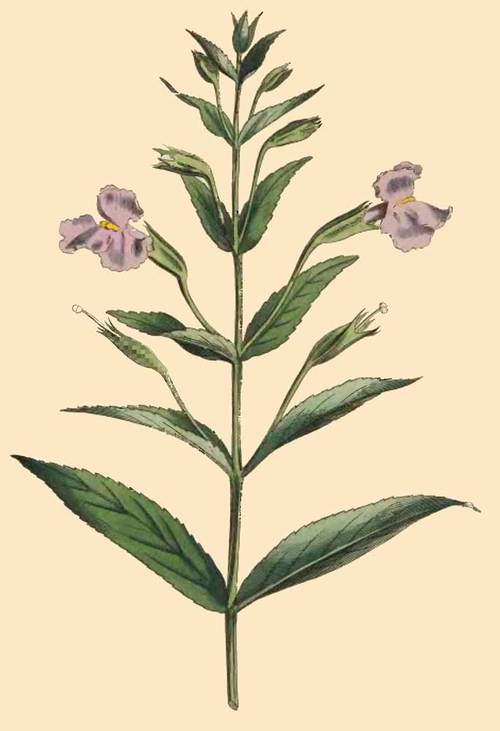
No. 283.
Clayton, in the Fl. Virg. published by Gronovius, describes this plant as a native of Virginia, and says of it, "maddidis gaudet locis," it delights in wet places: Linnaeus makes it a native of Canada also.
It is a hardy, perennial, herbaceous plant, growing with us to the height of about two feet, and producing its flowers, which are of a pale violet colour, in July and August; these are frequently succeeded by capsules containing perfect seeds, by which the plant may be propagated, as also by parting its roots in Autumn; Miller recommends the seeds to be sown as soon as ripe.
The plant succeeds best in a moist and somewhat shady situation, with a loamy soil.
A perusal of the synonyms will shew to what a variety of genera this plant has been referred by different authors; Linnaeus first gave to it the name of Mimulus, of which term we find in his Philosophia Botanica the following concise explanation: - "Mimulus mimus personatus;" in plain English, a masked mimick: Mimmulus is a classical word for the Pedicularis, or Lousewort; the English term Monkey flower has probably been given it, from an idea that mimulus originated from μιμω a monkey, as in mimusops monkey face.
Continue to:


My Books

