


1. Fothergílla Murr. Syst. Veg. 418. 1774
Description
This section is from the book "An Illustrated Flora Of The Northern United States, Canada And The British Possessions Vol2", by Nathaniel Lord Britton, Addison Brown. Also available from Amazon: An Illustrated Flora of the Northern United States, Canada and the British Possessions. 3 Volume Set..
1. Fothergílla Murr. Syst. Veg. 418. 1774
Shrubs, the foliage somewhat stellate-pubescent. Leaves alternate, obovate. Flowers perfect, or often polygamous (sometimes monoecious) in catkin-like bracted terminal spikes, appearing a little before the leaves. Calyx campanulate, slightly 5-7-lobed. Petals none. Stamens about 24, inserted on the edge of the calyx; anthers subglobose. Ovary 2-celled; styles slender; ovules 1 in each cell. Capsule cartilaginous, 2-celled, 2-seeded. Seeds bony, pendulous. [Named for Dr. John Fothergill, 1712-1780, an English naturalist.]
A monotypic genus of eastern North America.
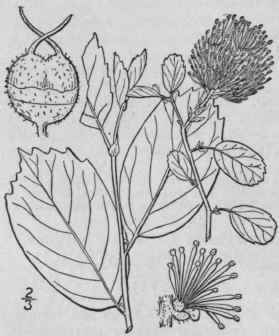
I. Fothergilla Gàrdeni Murr. Fothergilla
Fig. 2194
Hamamelis virginiana Carolina L. Mant. 333. 1771. Fothergilla Gardeni Murr. Syst. Veg. 418. 1774. Fothergilla alnifolia L. f. Suppl. 267. 1781. F. Carolina Britton, Mem. Torr. Club 5: 180. 1894.
A shrub, 2°-5° high, the young twigs densely stellate-pubescent. Leaves short-petioled, 2' - 3' long, obovate or broadly oval, obtuse or short-pointed at the apex, rounded or narrowed at the base, usually inequilateral, coarsely dentate-crenate above the middle, or entire, more or less stellate-pubescent; spikes dense, erect, 1'-2' long; bracts densely pubescent, the lower ones sometimes lobed; stamens white or pinkish, 2"-4" long; capsule very pubescent.
In wet grounds, Virginia to Georgia. Witch- or dwarf-alder. April.
Continue to:


My Books

