


Bunch-Flower Family. Large-Flowered Bellwort. Perfoliate Bellwort. Uvularia Grandiflora
Description
This section is from the book "Our Early Wild Flowers", by Harriet Louise Keeler. See also: Newcomb's Wildflower Guide.
Bunch-Flower Family. Large-Flowered Bellwort. Perfoliate Bellwort. Uvularia Grandiflora
Uvularia, from uvula, a palate, in allusion to the hanging flowers.
An erect, forked herb, perennial by rootstocks. Rich open woods. New England to Minnesota, south to Georgia and Tennessee. Frequent in northern Ohio. April, May.
Rootstock
Short, with fleshy roots.
Stem
Leafy, smooth, pale green, terete, one to two feet high, forked above the middle, bearing solitary terminal flowers, and usually a single leaf below the fork.
Leaves
Alternate, oblong or ovate-lanceolate, acute at the apex, smooth-margined, perfoliate, parallel-veined, two to four inches long, pubescent beneath.
Flowers
Yellow, lily-like, drooping, solitary, often hidden by the leaves, rarely two together, fragrant.
Perianth
Sepals and petals indistinguishable, six in number, an inch to an inch and a half long, lanceolate, pointed at apex, smooth within, nectar-bearing.
Stamens
Six, short, slightly adhering to the base of the perianth segments, longer than the styles; anthers linear, opening laterally.
Pistil
One; ovary three-lobed, three-celled; style three-cleft.
Fruit
Capsule, three-lobed and three-angled, cut off at the top. Seeds few in each cell.
Pollinated by bees and flies. Nectar-bearing.
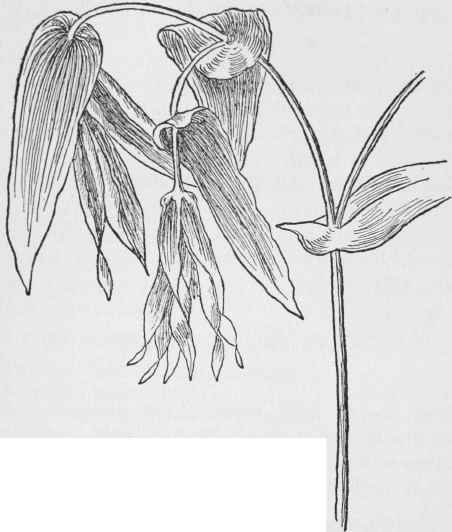
Large-Flowered Bellwort. Uvularia grandiflora
There are in our northern woods and among the early flowers three slender, shining, leafy plants twelve to twenty-four inches high, very similar in general appearance, yet with sufficient specific differences to make their selection and grouping a pleasure to the amateur. These are the Bellworts, growing usually in companies, recognized by their forking stems, their pale green, shining leaves whose veins run parallel, and when in bloom marked by their straw-colored or pale yellow, somewhat hidden, lily flowers. These vary from an inch to an inch and a half in length, have six sepal-petals indistinguishable from one another, six stamens, and a pistil.
The Large-Flowered Bellwort is the first to bloom in northern Ohio although it is not so abundant as either of the others. Its flower-bell is the largest of the three and the yellowest; it often measures an inch and a half in length; its ordinary rating of blossom is one to a stem. All the fertile stems fork above the middle and ordinarily bear one leaf below the fork, though sometimes this leaf is wanting. The leaves entirely surround the stem, giving the effect of being strung upon it.
Continue to:


My Books

