


Common Blue Violet. Viola Cucullata. Viola Palmdta, Var. Cucullata
Description
This section is from the book "Our Early Wild Flowers", by Harriet Louise Keeler. See also: Newcomb's Wildflower Guide.
Common Blue Violet. Viola Cucullata. Viola Palmdta, Var. Cucullata
Perennial, stemless flowers, violet-blue. Low grounds. Common throughout the north. Abundant in northern Ohio. April, May.
Rootstock
Short and thick.
Leaves
Smooth, deep green, roundish, heart-shaped, crenate; the sides rolled inward when young. When full grown the petioles are three to seven inches high.
Flowers
Deep or pale violet-blue, sometimes striped blue and white; besides the conspicuous flowers produced in the spring are others, produced later, which never open and are without petals.
Calyx
Five sepals, extending into ears at the base.
Corolla
Five unequal petals, the lower one spurred at the base, the lateral ones bearded.
Stamens
Five, the two lower bearing spurs which project into the spur of the corolla; filaments short and broad, often grown together.
Pistil
One; style club-shaped; stigma bent.
Pollinated by bumblebees or self-fertilized.
This is the commonest Violet of all, best known and best loved, which sometimes covers hollows and hillocks in such clouds that:
"One might guess A storm of blossoms had fallen there And covered the ground with a sweet excess."
Whoever, when a child, tumbled about in Violet fields, has fought many a battle royal with blue Violets. The blossoms having sturdy stems, with a curve just sufficient to grapple each other, make valiant warriors, and sometimes a hero would arise who could overthrow an entire phalanx of lesser blossoms.
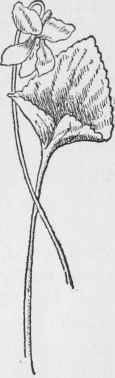
A Warrior Blossom of Blue Violet.
Viola cucullata
The leaves are not yet mature and are more or less rolled inward at each side when the first blossoms appear. These are usually a deep violet-blue marked with hair-lines, but sometimes are pale blue, sometimes blue and white striped. The arrangement of stamens and pistil implies the coming of the bee, and when she does not come the flowers mature no seeds. Possibly more than one observer has noted that no matter how abundant may be the blue blossoms - they may fairly carpet the earth - there is no corresponding production of seed. There usually is some, but not at all what one would expect.
However, though neglected by its friend, the Blue Violet is not without resources. Many species are able to do the same thing, but the Blue Violet does it more abundantly. It produces close to the ground on short stems, often hidden under the leaves, the merest apologies for flowers - no petals, no nectar, half closed. They look like flowers that have aborted or like blasted buds, but within each are stamens and ovules. The home pollen fertilizes the pistil and soon the wretched little flower is changed into a plump, healthy capsule full of seeds. These curious blossoms are produced throughout the entire summer.
Continue to:


My Books

