


Grape-Hyacinth. Muscari Botryoides
Description
This section is from the book "Our Early Wild Flowers", by Harriet Louise Keeler. See also: Newcomb's Wildflower Guide.
Grape-Hyacinth. Muscari Botryoides
Muscari, from the musky scent of one species of the genus.
One of the early flowering, bulbous perennials of country gardens which has escaped into lawns and fields. Naturalized from Europe. March, April.
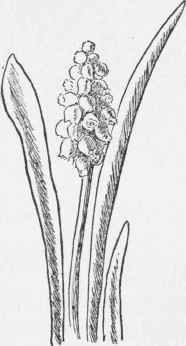
Grape-Hyacinth. Muscari botryoides
Leaves
Basal, linear.
Flowers
Violet-blue to pure blue, borne in a dense raceme on a naked scape, four to six inches high.
Perianth
Globular or urn-shaped, constricted at mouth; violet-blue, white at the mouth, six-toothed.
Stamens
Six.
Pistil
Ovary three-celled, forming a triangular three-celled capsule.
This is a hardy little bulbous plant from central Europe, common in gardens from which it has in many places escaped to the fields. Several species are in cultivation, but the one that everybody knows is Muscari botryoides, which means, like a bunch of grapes.
Continue to:


My Books

