


Ground-Pink. Moss-Pink. Phlox Subulata
Description
This section is from the book "Our Early Wild Flowers", by Harriet Louise Keeler. See also: Newcomb's Wildflower Guide.
Ground-Pink. Moss-Pink. Phlox Subulata
Perennial. In dry, sandy or rocky soil, extensively cultivated as an early blooming plant. New York to Michigan, south to Florida and Kentucky. Escaped from cultivation in New England. Rare in northern Ohio, except in gardens. April, May.
Stems
Much branched, forming mats; branches two to six inches long.
Leaves
Crowded, awl-like, acute or acuminate, spreading.
Flowers
Pink-purple or white, clustered at the ends of the branches.
Calyx
Tubular, five-lobed.
Corolla
Salver-shaped, five-lobed, tube slender; lobes slightly notched at the apex.
Stamens
Five, inserted on the tube of the corolla and alternate with its lobes, included.
Pistil
Ovary three-celled; style slender; stigmas three.
Fruit
Ovoid capsule, three-celled, three-valved, several-seeded.
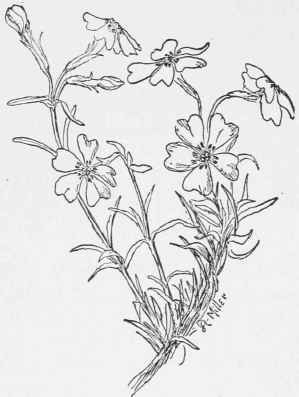
Moss-Pink. Phlox subulata
The Moss-Pink under cultivation sets the garden ablaze with brilliant bloom and lights up the desolation of early May. The depressed stems with their little sharp-pointed leaves make dense mats of mosslike foliage, and when in flower these mats are transformed into a mass of rose-purple, pink, or white, so perfectly does the bloom hide the foliage. Rocky hillsides and rocky banks are its natural home, but any light soil will serve.
Continue to:


My Books

