


Jeffersonia. Twinleaf. Jeffersonia Diphylla
Description
This section is from the book "Our Early Wild Flowers", by Harriet Louise Keeler. See also: Newcomb's Wildflower Guide.
Jeffersonia. Twinleaf. Jeffersonia Diphylla
Named in honor of Thomas Jefferson.
Perennial. In moist open woods. Western New York to Wisconsin, and south to Virginia and Tennessee. Found in northern Ohio. April, May.
Rootstock
Thick, horizontal, fleshy, with many fibrous roots.
Leaves
All basal, forming a tuft, long-petioled, parted into two leaflets, which when fully grown are three to four inches long and two inches wide; ovate, entire, or obscurely toothed or sinuate.
Flowers
Solitary, white, with the general appearance of Bloodroot, borne on a scape six to eight inches high.
Calyx
Of four sepals, falling as the flower opens.
Corolla
Of eight oblong petals, white, longer than the sepals.
Stamens
Eight, shorter than the petals, opposite them; anthers extrorse.
Pistil
One; ovary one-celled; stigma peltate.
Fruit
Capsule obovoid, opening with a lid, called a pyxis; seeds many, crowded.
Jeffersonia is a smooth, perennial herb with matted fibrous roots, long-petioled root-leaves that are parted into two half-ovate leaflets, and bears in early April white flowers very similar to those of Bloodroot. It is a plant of the Middle West, is not reported east of the Hudson valley and is to be looked for on calcareous soil; consequently it is not very well known, nor is it in its habitat very abundant, though it is not rare.
Its botanical name is in honor of Thomas Jefferson, but its common name, Twinleaf, is due to the fact that the leaf is parted into two similar leaflets. From its supposed medicinal qualities it is sometimes called Rheumatism-Root. The fruit of jeffersonia is what the botanists call a pyxis, that is, a round box full of seeds, which when ripe has a lid which turns back and lets them out.
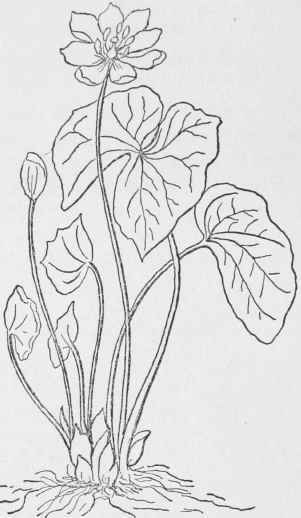
Twinleaf. Jeffersonia diphylla After Gray's "Genera Plantae Americas"
Continue to:


My Books

