


Kidney-Leaved Crowfoot. Small-Flowered Buttercup. Ranunculus Abortivus
Description
This section is from the book "Our Early Wild Flowers", by Harriet Louise Keeler. See also: Newcomb's Wildflower Guide.
Kidney-Leaved Crowfoot. Small-Flowered Buttercup. Ranunculus Abortivus
Biennial. Shady hillsides, along brooks, in open woods. Newfoundland, Labrador, Nova Scotia to Manitoba, south to Florida, Arkansas, and Colorado. Common in northern Ohio. April-June.
Roots
Thick-tufted fibres.
Stem
Smooth, branching, about a foot high.
Leaves
First basal leaves one or two inches in diameter, long-peti-oled, bright green, kidney-shaped or round heart-shaped; the succeeding ones often three-lobed or three-parted; stem-leaves three to five-parted, nearly sessile, divisions oblong or wedge-form, mostly toothed.
Flowers
Small, yellow, with globular centres, more green than yellow.
Calyx
Sepals five, ovate, obtuse, somewhat yellowish, and reflexed.
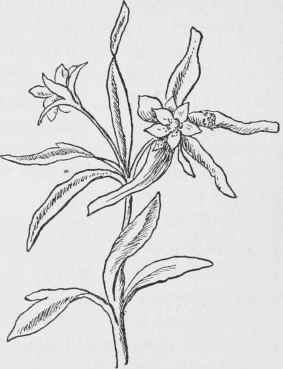
Small-Flowered Buttercup. Ranunculus abortivus
Corolla
Petals five, small, pale yellow, with scale at base, shorter than the sepals.
Stamens
Many.
Pistil
Many carpels, each tipped with minute curved beak.
Fruit
Globular head of akenes.
Pollinated by bees and flies. Nectar-bearing.
The Small-Flowered Buttercup is abundant in northern Ohio. Its first primary leaves are round, heart-shaped, or kidney-shaped. Those that come later are often three-parted. The petals are small, so that the effect of the flower is very little yellow corolla and a great deal of green calyx and green centre. Indeed, the blossom does not look very much like a Buttercup, and, compared with the well-known Buttercups, bright and yellow, this little green ball with five yellow tips seems scarcely worthy of the name; yet it is a true Ranunculus, and is underfoot everywhere in moist open woods, making great root masses as well as tufts of stems.
The Bulbous Buttercup, Ranunculus bulbosus, is also an April bloomer. It is a species whose stem is bulbous-thickened at base, which gives it its common name. The leaves are three-divided and the segments variously cut and lobed. The flower is about three-fourths of an inch across and bright yellow. The plant is not native but came to us from Europe.
Continue to:


My Books

