


Labiate - Mint Family. Ground-Ivy. Gill-Over-The-Ground. Nepeta Glecoma. Glecoma Hederacea
Description
This section is from the book "Our Early Wild Flowers", by Harriet Louise Keeler. See also: Newcomb's Wildflower Guide.
Labiate - Mint Family. Ground-Ivy. Gill-Over-The-Ground. Nepeta Glecoma. Glecoma Hederacea
Perennial. Naturalized from Europe. Found in damp or shaded places. Newfoundland, Ontario, and Minnesota, south to Georgia and Kansas. Common in northern Ohio. April-September.
Stem
Square, creeping and trailing, leafy, often forming dense green mats.
Leaves
Opposite, petioled, round kidney-shaped, scalloped, green throughout the winter, downy.
Flowers
Violet-blue, two-lipped, in loose axillary clusters.
Calyx
Tubular, obliquely five-toothed.
Corolla
Two-lipped; upper lip is erect and notched at the middle and arches over stamens and pistil. The lower lip, violet, spotted with dark purple, is three-lobed, middle lobe largest.
Stamens
Four, in two pairs ascending under the upper lip; the lower pair the shorter, inserted on the tube of the corolla.
Pistil
Four-lobed; style two-lobed.
Fruit
Four little nutlets.
Pollinated by many insects. Anthers and stamens mature at different times in most of the flowers.
In Europe, where the aromatic leaves of this little creeper were long ago used for fermenting and clarifying beer, it is known by such names as Ale-Hoof and Gill-Ale - gill,it is said, being derived from the old French word guiller, to ferment or make merry. Be that as it may, the plant is an old and familar herb, formerly much used as a domestic remedy, and, like so many of those old-time remedies, probably worthless. The trailing stem grows sometimes twelve inches or more in length, with ascending branches, and, like all the mints, it is square; moreover, it roots at the joints, thus possessing an easy means of forming new plants. The leaves are soft and downy to the touch, of bitterish and aromatic taste, so that cattle avoid them. The plant often forms dense mats and its leaves are green all winter; in the spring it comes into flower pretty punctually in early April.
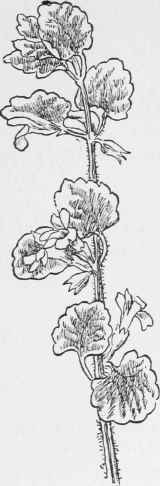
Gill-over-the-Ground. Glecoma hederacea
Continue to:


My Books

