


Portulacaceae - Purslane Family. Spring-Beauty. Claytonia Virginica
Description
This section is from the book "Our Early Wild Flowers", by Harriet Louise Keeler. See also: Newcomb's Wildflower Guide.
Portulacaceae - Purslane Family. Spring-Beauty. Claytonia Virginica
Claytonia, in honor of Doctor John Clayton, a Virginian botanist.
Perennial. In thin moist woods. Nova Scotia to the Northwest Territory, southward to Georgia and Texas.
Abundant in northern Ohio. March-May.
Stem
Simple, from a small, deep tuber, often reclining, frequently stained with red.
Leaves
Two, opposite, long and narrow.
Flowers
Pink with deeper pink veins, growing in a loose raceme, opening a few at a time, one-half to three-fourths of an inch across; pedicels slender, at length recurved.
Calyx
Of two sepals, ovate, persistent.
Corolla
Of five petals, slightly united at the base, and notched at the apex.
Stamens
Five, attached at the base of the petals; filaments white.
Pistil
One, with style three-cleft at the apex.
Pod
One-celled, three-valved, three to six-seeded.
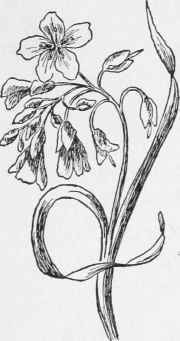
Spring-Beauty. Claytonia Virginica
Pollinated by bees, flies, and butterflies. Anthers mature before the stigma.
"Where the fire had smoked and smouldered, Saw the earliest flower of Spring-time, Saw the beauty of the Spring-time, Saw the Miskodeed in blossom."
- "Hiawatha," Longfellow.
The Spring-Beauty grows in moist and sunny places in the open wood, generally in colonies scattered over a considerable area. The single stalk springs from a small, deeply seated, tuberous root, is pale green, often stained with red. The leaves are two, long, narrow, fleshy, with a distinct midrib, entire margin, and pointed at base and apex.
The blossoms are borne on the stem in a one-sided raceme, are white or pale pink with darker pink vein-ings and less than an inch across when fully expanded. They open fully only in the sunlight, and if the day is cloudy the corolla closes.
Because the flowers appear in a raceme, the plant has a longer period of bloom than the Hepatica whose flowers are solitary; that is, a single plant of Spring-Beauty will produce perhaps ten or twelve blossoms during the season, but not more than three or four are perfect at any one time, and this greatly extends the flowering period.
Carolina Spring-Beauty, Claytonia Caroliniana, is found in damp woods, not abundantly throughout the range of Virginica. The chief specific difference lies in the broader leaves and fewer flowers. The period of bloom extends from March to May. Reported in northern Ohio.
Continue to:


My Books

