


Potentilla. Five-Fingers. Potentilla Canadensis
Description
This section is from the book "Our Early Wild Flowers", by Harriet Louise Keeler. See also: Newcomb's Wildflower Guide.
Potentilla. Five-Fingers. Potentilla Canadensis
Potentilla, from potens, powerful, because some members of the species have medicinal value.
Perennial. Roadsides and fields, growing in mats and patches; common and variable; produces summer runners. Nova Scotia, New England, south to Georgia, west to Minnesota and Indian Territory. Abundant in northern Ohio. April-September.
Roots
Fibrous, sending out summer runners that root at the tip.
Stem
Slender, with silky hairs, at first decumbent or prostrate, afterward frequently erect.
Leaves
Petioled, compound, really three-parted, but apparently five-parted because the lateral leaflets are cleft; leaflets serrate, pointed.
Flowers
Yellow, solitary, on slender stems, borne in the axils of the leaves.
Calyx
Deeply five-cleft with bracts between the teeth, thus appearing ten-cleft.
Corolla
Of five broad, rounded petals, notched at the apex and showing the hairy green calyx.
Stamens
Many; filaments slender; anthers small.
Pistils
Many, forming a dense little bunch of green in the centre of the flower.
Fruit
A head of akenes.
In fields and on roadsides in April and May one finds beds of Potentilla which are dotted over with bright, uplooking yellow flowers -"luikin oot o' their leaves like wee sons of the sun." The flowers suggest yellow Wild Strawberry blossoms; the two appear about the same time, and frequently the beds are side by side, sometimes intermixed. Structurally, there is not much difference between a Potentilla and a Strawberry blossom, but practically there is a great deal, for one produces a strawberry and the other does not.
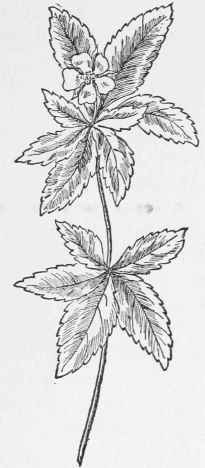
Potentilla. Potentilla Canadensis
Later in the summer there are fewer blossoms, but the inquiring tips of the little runners are very much in evidence. The name Five-Fingers was suggested by the shape of the leaf, which has five leaflets standing out like the fingers of a hand. These leaves are among the last to disappear in the woodlands under the blankets of November.
Continue to:


My Books

