


Scrophulariaceae - Figwort Family. Collinsia. Collinsia Verna
Description
This section is from the book "Our Early Wild Flowers", by Harriet Louise Keeler. See also: Newcomb's Wildflower Guide.
Scrophulariaceae - Figwort Family. Collinsia. Collinsia Verna
Collinsia, dedicated to Zaccheus Collins, botanist, of Philadelphia.
Biennial or winter annual. Moist meadows, woods, and thickets. Western New York and Pennsylvania to Wisconsin, Kentucky, and Oklahoma. Rare in northern Ohio. April-June.
Stems
Hoary or smooth, weak and slender, six to twenty inches high, branching.
Leaves
Thin, opposite, the lower ovate or orbicular, obtuse, crenate or entire, slender-petioled; the middle leaves sessile or clasping, ovate or oblong, obtuse, dentate; floral leaves ovate to spatulate, mostly acute.
Flowers
Blue and white, two-lipped; borne in about six-flowered whorls in the axils of the upper leaves.
Calyx
Deeply five-cleft.
Corolla
Irregular, declined, with the tube bulging at the base on the upper side, deeply two-lipped; upper lip white or pale purple, two-cleft; the lower lip blue, three-lobed, the side lobes spreading, the middle lobe folded lengthwise to enclose four adhering stamens and one pistil; about three-fourths of an inch long.
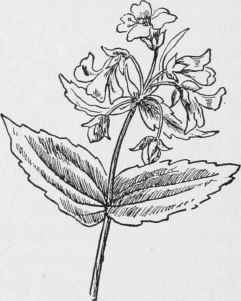
Collinsia. Collinsia verna
Stamens
Four perfect stamens, the fifth a gland-like rudiment; all inserted on the tube of the corolla.
Pistil
One; style threadlike; stigma small.
Fruit
A round capsule to which the enlarged calyx adheres; seeds few.
Pollinated by bees. Stamens mature pollen at different times.
Collinsia is a flower of delicate beauty, rare in northern Ohio but covering acreage in the West and Southwest when permitted so to do. It loves moist alluvial soil and is rarely found elsewhere. Its beautiful blue and white corolla is deeply two-lipped, the upper lip two-cleft with its lobes partly turned backward, the lower is three-cleft, its middle lobe sac-like and ridged, enclosing the stamens and the style.
The plant was named in honor of Zaccheus Collins, a Philadelphia botanist, and seems never to have gained a common name.
Continue to:


My Books

