


Tiarella. Tiarella. False Mitrewort. Foam-Flower. Tiarella Cordifolia
Description
This section is from the book "Our Early Wild Flowers", by Harriet Louise Keeler. See also: Newcomb's Wildflower Guide.
Tiarella. Tiarella. False Mitrewort. Foam-Flower. Tiarella Cordifolia
Tiarella, diminutive from tiara, a turban, from the form of the pistil, which is similar to that of Mitella, to which the name Mitrewort, properly belongs.
Perennial. Found in colonies on wooded hillsides, bearing in early May dense masses of feathery white flowers. Nova Scotia, Ontario, and Minnesota, south to Georgia. Abundant in northern Ohio. April, May.
Rootstock
Horizontal, running.
Stem
Six to twelve inches high, usually leafless, hairy, sometimes bearing two leaves.
Leaves
Heart-shaped, sharply lobed and toothed, sparsely hairy above, downy beneath, long-petioled from the rootstock.
Flowers
Small, white, loosely clustered in terminal, feathery spikes.
Calyx
Bell-shaped, white, five-parted.
Corolla
Petals five, white, clawed, pointed-oblong.
Stamens
Ten, long, slender, orange-tipped.
Pistil
One; ovary one-celled; styles two.
Fruit
Capsule, one-celled, two-valved; seeds few, smooth.
Pollinated by bees.
A single Tiarella by itself is an exceedingly beautiful plant but it also grows in mass sufficiently to make an impression by numbers. The many long-petioled, heart-shaped leaves spring from the horizontal root-stock or from the runners that the plant sends out. Any plant that develops runners forms beds. By middle April or early May this lush, green border of the woodlands becomes a mass of stems six to twelve inches high, each bearing at its summit a crowded raceme of white, five-pointed, starry flowers.
Both Mitella and Tiarella are named from the peculiar shape of the pod or pistil, which in each resembles a mitre, or bishop's cap. The two plants are usually found together, but the Tiarella blooms a little later than the other and is the more conspicuous of the two.
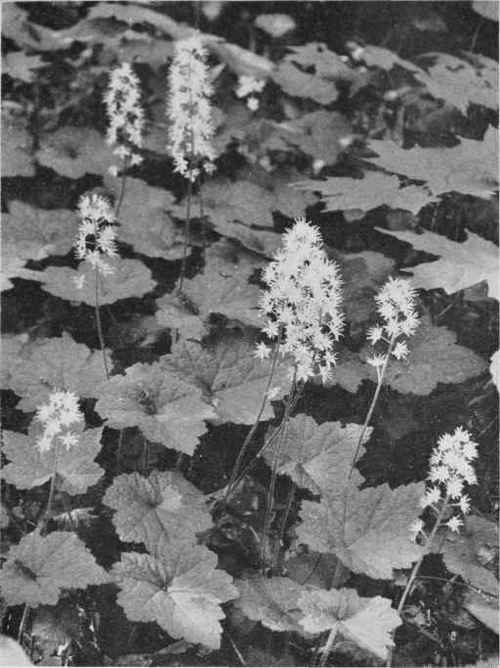
Tiarella at Home. Tiarella cordifolia
Continue to:


My Books

