


Chapter I. Candy Ingredients And Necessary Equipment
Description
This section is from the book "Candy Cook Book", by Albert R. Mann. Also available from Amazon: Candy Cook Book.
Chapter I. Candy Ingredients And Necessary Equipment
Candies are composed of sugar of various kinds, chocolate, nuts, fruits, colorings, and flavorings. Each of these has its own particular value as appealing to the sense of sight, the sense of taste, or the need of the body for nourishment.
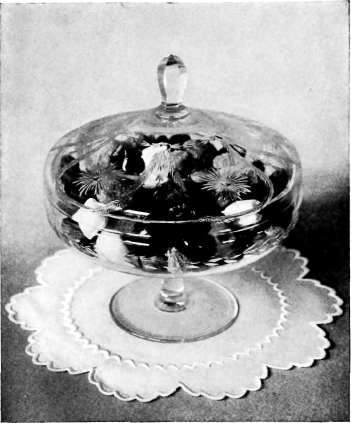
A Dish Of Bonbons - Frontispiece.
Sugar
Sugar (C12H22O11) is a crystalline substance known by its sweet taste and its solubility in water. Sugar undergoes little change during digestion as glucose it is carried by the blood through the body, and unites with oxygen breathed in from the air, forming carbon-dioxide (CO2), gas, and water, in which forms it leaves the body.
During this change, energy is produced, and used for muscular work. Sugar is more rapidly oxidized than any other kind of foodstuff, and makes a very desirable quick fuel food. The principal kinds of sugar are cane sugar or sucrose, grape sugar or glucose, milk sugar or lactose, and fruit sugar or cellulose.
Sugarcane is obtained from sugar cane, sugar beets, and maple trees. It is sold in many forms. Granulated sugar is the kind most commonly used in candy-making. It is made by dissolving, filtering, and crystallizing the raw sugar that has been extracted from the sugar cane or sugar beet-Brown sugar is not so completely refined as white sugar and has more flavor. Keeping it in a covered jar in a cool place prevents it from becoming lumpy.
Powdered sugar is cane sugar, finely ground, but still slightly granular. Confectioners' sugar is cane sugar so very finely ground that it is like a powder, and dissolves instantly. In recipes where it is called for other sugar cannot be substituted, although confectioners' sugar can be used in place of powdered or granulated sugar. It is a pure form of sugar with nothing added to it.
Molasses is a by-product in the manufacture of sugar, and cannot be crystallized with ordinary methods.
Maple sugar is obtained by boiling down the sap obtained by tapping maple trees. Its delicious flavor is due to "impurities" that are present. Maple syrup can be made by dissolving maple sugar in boiling water, or by using the maple sap before it has been sufficiently reduced to become crystalline. The amount produced in this country each year is by no means sufficient to supply the demand, and consequently there are many imitations.
Grape sugar or glucose, found in honey and all sweet fruits, is less sweet than cane sugar. It may sometimes be seen on the outside of dried fruits such as dates and raisins. It is manufactured on a large scale from cornstsrch, and is for sale as glucose in kegs and barrels of no, 300, and 650 pounds each. As corn syrup or Karo, where it is combined with sugar syrup, it can be obtained in red label and blue label tins of one and one half and two and one half pounds capacity. When used in candies it prevents crystallization and gives a smoother product.
Milk sugar or lactose is present in milk, and when separated from it is sold as milk sugar. It is not sweet, and is only found in candy when milk is used. Fruit sugar or levy lose is found in sweet fruits. It is sweeter than cane sugar and too expensive for ordinary use.
Chocolate
Chocolate is obtained from cocoa beans cleaned, roasted, and finely ground. It contains much nourishment, in a concentrated form, fat, protein, and carbohydrate being present, with very little water.
Chocolate used on the outside of candies is called coating chocolate. Large candy manufacturers grind and blend cocoa beans to get the particular grade of chocolate coating for which they are famous. Sugar and vanilla are added, and any chocolate sold by name can be relied upon. It is for sale in ten-pound cakes, and should cost not less than twenty-five cents a pound for a good quality. There is upon the market a sweet coating chocolate in one sixth and half-pound cakes, in red wrappers. This can be obtained from grocers, and is very satisfactory.
Bitter or unsweetened chocolate has had nothing added to it, and should be used in fudges and other candies in which chocolate is cooked with sugar. It is for sale in quarter and half-pound cakes, divided into small squares, each weighing one ounce. Bitter chocolate is combined with sweet chocolate, and used for coating "bitter sweets."
Cocoa is prepared from cocoa beans by the removal of a portion of the fat. Sugar, flavorings, and sometimes stsrch are added. Cocoa butter is the fat obtained from the cocoa bean in the manufacture of cocoa. A small amount is sometimes added to melted chocolate to keep it thin enough for dipping, at a moderate temperature.
Continue to:


My Books

