


170 - Roast Beef
Description
This section is from the book "Cooking For Profit", by Jessup Whitehead. Also available from Amazon: Cooking for Profit.
170 - Roast Beef
To roast or bake meat so that, however small the piece may be, it will be found full of gravy when cut, it is necessary to have the pan it is baked in hot before the meat goes in, and although there must be liquor in the pan while it is baking, that should be added after the meat has become hot enough outside for the pores to be closed and juices retained inside.
The choice roasting piece of beef is the ribs between the edge of the shoulder-blade and the loin - the short ribs. As the butchers have to sell everything, as a matter of business, they take out the rins and coil the thin meat of the breast around the choice upper portion, and make a neat cushion-shaped roast, secured with twine and skewers. In the places where the highest prices are paid, however, the breast portion has to be cut away altogether and cooked separately, as in our example of last week, and the choice upper portion or entre-cote only is roasted. This is nearly always cooked rare done, and the plentiful gravy that flows from it when cut is caught in a dish and is the only gravy served with it. As to time, the old rule is the only one. Allow a quarter of an hour for each pound of meat, and less, according to judgment, when the roast is of thin shape or required to be very rare done.
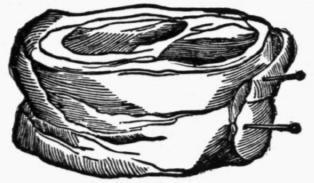
Common Roast of beef. To be carved by slicing off the top.
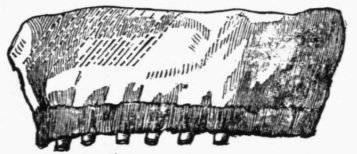
Choice roast, close trimmed and the spine bone removed. To be carved by cutting entire slices off the end.
Cost of roast beef - common roast beef at 12c, loses one-third in trimmings and cooking - 1 pound 18c, 6 plates to the pound, 3c per plate. Choice roast at 18c, same proportions, 6 plates to the pound 41/2c per plate.
Continue to:


My Books

