


Conclusion. Continued
Description
This section is from the book "Cooking For Profit", by Jessup Whitehead. Also available from Amazon: Cooking for Profit.
Conclusion. Continued
Epitaph
This man was too advanced for use,
He had to great a head. He worked his" Settle-Down" in French -
His settle-up in lead.
From the Hotel Register, N. Y,
Hotel Carving
Certain men who practise the same set of duties every day will acquire extraordinary dexterity in their line, and they are the men to watch if one would learn all the sharp cuts in carving. George McG - , a Southern hotel keeper was one of these fine carvers, but rather off-hand and wasteful with it, for he was full of other business and would not dwell upon trifles; he was for rapidity and did not stop to clean all the meat from the carcasses; left them to be stripped afterwards for salad or hash. There was another man employed in his house, a professional carver, Jake Carter by name, and one day he said:
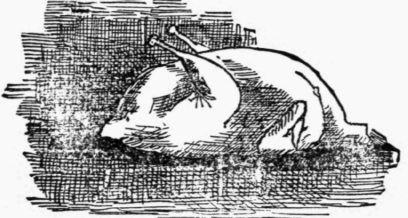
Philadelphia Capon.
"Mr. McG - , how many orders do you think I can get off this turkey ?"
"Oh - I don't know - how much does it weigh?"
"Here it is - you can judge for yourself."
"Well - that turkey weighed 12 pounds before it was cooked -1I suppose I could carve 35 or 40 orders from it if I was trying, and I don't think there are many carvers around here can beat me."
"Mr. McG - I think I can just about double that number for a five dollar bet."
"I'll bet you a ten dollar gold piece against seven days wages you can't beat it over ten dishes" - returned McG - and not thinking any more about the matter he turned on his heel and went off to the front of the house. But Jake Carter called witnesses to watch and off that one turkey he carved and sent in 70 passable orders. It was nearly two years before McG - would pay the bet, and then he was greatly in need of Carter's services at a banquet and was obliged to pay it; but that was only one specimen of Carter's skill as a carver which has been so valuable to him that he has had fourteen years constant employment in one city, the time being divided between only two hotels.
The art and the difficulty of it consists in slicing broad but thin, even as thin as paper.
Of course there are two sides of the carving question and the consumer may not see the subject in the same pleasing light that the calculating hotel man does; there must be a medium observed that will result in giving satisfaction to the guests at table, yet it is so true that nearly all hotel dishes contain twice as much as they need and the cost of provisions is needlessly increased in that way that a skillful carver who can make a dish look broad and plentiful without giving it much weight may be the most valuable man in the house. Some men are not adapted to become good carvers; quick, impatient, irritable men are not. It takes an easy-going imperturbable person who cuts smoothly with long and steady strokes and does not see-saw and scatter the splinters. The knives must be thin and as keen as razors; there can be no good carving with the ordinary kitchen knives which are used for all purposes, and withal, the carver must know where the joints are so well that his sharp knives will pass through them without contending against the bones. With such a keen knife the breast of a small chicken can be laid open so as to top cover four dishes, which would not make any showing upon two dishes in the hands of a clumsy carver, and a large chicken will cover six or eight.
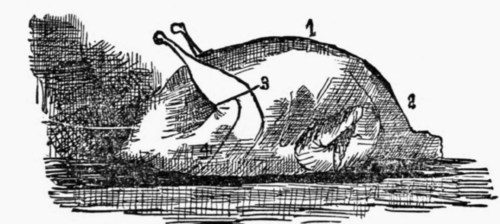
American Thanksgiving Turkey.
The method is, to place a spoonful of the stuffing in the dish, slice meat off the drumstick and place beside it, or a joint of the wing and on top lay the white meat as broad and thin as the size of fowl will allow.
While such directions may read well enough it will be found the practice is not so easy unless pursued with steady system. Take up the chicken by inserting the fork in the cavity of the neck, where the crop was, and keep the fork there in one place until the fowl is disjointed and the breast is in slices. First take off the legs and thighs, cutting to the hip joint, then with a turn of the wrist throwing it out of the socket and pass the knife clear through, hold up the carcass and strike the knife through the small of the back and the lower part or side bones fall off. Then remove the wings at the sockets. Next take off the first slice - the brown outside - of the breast. If a large fowl you can get a broad slice more of white meat before touching the bone. Next to that is the fowl's shoulder-blade, a bone almost like the wishbone, imbedded in the white meat and very much in the way of the carver who is not posted; but your knowing hand takes hold of it by the projecting knob, which is the wing socket, and gently pulls it off and the whit' meat that comes with it and covers it, and it makes a slice itself almost as thin and quite as broad as the others. Under that and lying close to the breast bone is another layer to be taken off with the point of the knife and that makes four slices of white meat from one side, eight from the two sides, to make the tops of dishes partly made up of a slice from the leg, or a side bone or split of the upper part of the back.
In carving a turkey the proceeding is the same but less difficult as there is more meat to work on. The usual way, which was the way Mc-G - did, is to place the carving fork astride of the breast bone and keep it there until the turkey is all cut up, but Carter objected that thrusting the fork in there cut through a slice of the white meat in the best part on each side of the bone and he took a hold in the crop cavity as already mentioned.
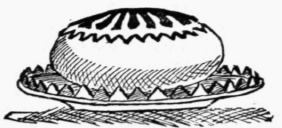
Boned Chicken with Jelly.
Continue to:


My Books

