


(1583). Recipes For Calves' Tongues (Langues De Veau)
Description
This section is from the book "The Epicurean", by Charles Ranhofer. Also available from Amazon: The Epicurean, a Complete Treatise of Analytical and Practical Studies on the Culinary Art.
(1583). Recipes For Calves' Tongues (Langues De Veau)
(1583). Calves' Tongues A La Flamande (Langues De Veau A La Flamande)
How To Salt The Calves' Tongues
Take out the pipes from twelve tongues; prick them all over with a coarse trussing needle and put them into a stone vessel containing sixteen quarts. Dissolve a sufficiency of salt in ten quarts of water so that when an egg is dropped in, it will float on the top; add four ounces of saltpetre, and when all is thoroughly dissolved, pour it over the tongues. Set them in a cool place, and leave them there for twelve days, turning them over every third one. Drain and cook them plainly in water with some chopped beef suet, and when done, peel off the skins and keep the tongue warm in a light half-glaze sauce (No. 413); dress and surround them with a Flemish garnishing (No. 668), pouring over a clear gravy (No. 404).
(1584). Calves' Tongues A La Perigueux (Langues De Veau A La Perigueux)
On the center of a round dish fasten a wooden bottom covered with cooked paste ( No. 131) and having a six inch high pyramidal support in the center, also covered with paste; brush the whole with meat glaze (No. 402). Cook six or seven large calves' tongues in water, selecting those which have been in brine for twelve days. Roll out on a floured table a thin band of half puff paste ( No. 146), three and a half to four inches wide; roll it on a roller to unroll on a baking sheet slightly wetted with water, then with a cardboard pattern cut from this band large pieces, straight on one side and rounded on the other, one end being pointed while the other is straight, and on the rounded side cut. it into small sharp points; prick the surfaces, egg over with a brush without touching with the hands, and cook them in a slow oven until they become a light golden color; after removing let get partially cold under a very light weight. Drain the tongues, peel and keep them for ten minutes under a weight to flatten lightly; pare and cut each one in two or three pieces from top to bottom, then reconstruct them as they were before, and cover the cut sides with a layer of soubise (No. 723), reduced and thickened with a little meat glaze (No. 402), and slightly cool; keep them their correct shape, afterward glaze them over with a brush: cover the wooden bottom and surround the central support on the dish with a thick bed of good risot ( No. 739), and stick on top of this support a small skewer garnished with truffles.
Dress the tongues upright, leaning them against the rice, lay between each one of the bands of paste to separate the tongues, letting them project slightly beyond. Cover over with a Madeira sauce (No. 492), reduced with truffle parings, and send a separate Perigueux sauce (No. 317;, to the table at the same time as the tongues.
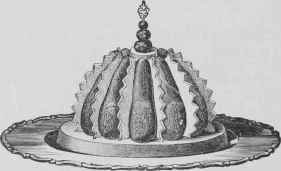
Fig. 333.
Continue to:


My Books

