


(179). How To Dress, Singe And Truss Poultry And Game For Roasting. (Pour Habiller, Flamber Et Brider La Volaille Et Le Gibier A Plumes Pour Rotir)
Description
This section is from the book "The Epicurean", by Charles Ranhofer. Also available from Amazon: The Epicurean, a Complete Treatise of Analytical and Practical Studies on the Culinary Art.
(179). How To Dress, Singe And Truss Poultry And Game For Roasting. (Pour Habiller, Flamber Et Brider La Volaille Et Le Gibier A Plumes Pour Rotir)
Dressing poultry and feathered game consists of first bleeding, then plucking out the feathers, drawing, singing and trussing them. To dress a chicken it must first be singed lightly all over with spirits of wine set afire, or over a gas-jet, in order to remove every vestige of feathers. "When the poultry or game is singed, then pick out all the feather-stumps remaining in the skin. Burn off the skin from the legs to enable it to be taken off with a cloth. To singe small birds stick them simply on small skewers four or six at a time and pass them over a flame. For drawing a chicken cut on the back of the neck making a long aperture through which the pouch and wind pipe can be removed; put the index finger into the interior following the neck to detach the lungs adhering to the inside; make a small opening next to the rump to empty the chicken entirely and then wipe out the insides, cut the skin below the head, chop the neck off on a level with the breast chop off the feet and the end of the pinions and cross the wings over the back of the chicken.
Thread a long piece of string into a large trussing needle, lay the chicken on the table, pressing it down on its back, then with the open left hand take hold of the two thighs, so as to keep them held up at an equal height, pass through the flesh with the needle just below the drum-sticks, turn the chicken over on its side to thread it through the wings, running the needle through the breast skin: pull the string tight tie it on the side with a knot, and lay the chicken once more on its back, press the thighs down again with the left hand and run the needle through above the drumsticks, then turn the chicken over on its side, and introduce the needle across the carcass, and at a quarter of the length of the bird near the rump to the other side, to meet the other end of the string and then tie it into a knot (Fig. 106). In this manner the chicken is properly trussed, and both knots being on the same side, they are easily cut and the string pulled out when the chicken is cooked. Pheasants, partridges and pigeons are to be trussed the same way when intended for roasting.
After the poultry or game is trussed, lard it with thin slices of fresh pork, sufficiently large to cover the whole breast, pare them square shaped, score them lightly on one side, and lay them over the breast, fastening them on with a string as shown in Fig. 109.
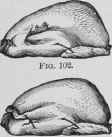
Fig. 103.
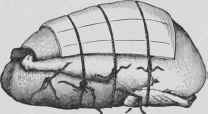
Fig. 104.
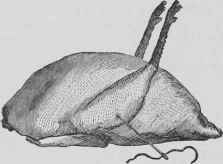
Fig. 105.
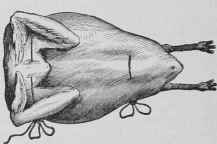
Fig. 106.
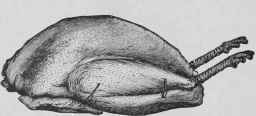
Fig. 107.
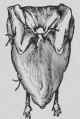
Fig. 108.
Fig. 109.
Wild Bucks (Canvas Backs, Red Heads, Black Heady, Mallard, Buddy, Teal, etc.). - Select two fine red head ducks, pick them as far up as one inch from the head, being very careful not to tear the skin; singe and draw. In order to accomplish this, the skin must be cut the whole length of the neck from its beginning until the back of the head is reached, remove the pouch and windpipe, stick the finger in the neck far down in the inside to detach the lights from the bones and all adhering to the breast, make an incision above the rump and take out the gizzard drawing up the whole .,[' the insides; ent the neck where it begins at the carcass, cutting the skin as far up as it is picked. Wipe the duck carefully, thrust the feet inside and season it interiorly with salt and mignonette. Should the duck be gamy it must have the inside washed out. Pick the feathers from the head and separate it where the neck finishes: pick out the eyes and place the head in the opening that was used for drawing the bird; truss the duck bringing the feet toward the front and passing the trussing needle threaded with string near the first joint of the thigh next to the feet.
Run the needle through the duck under the breast and then across the other thigh, pressing the duck down well so as to round well the breast, bring the neck skin down on the back and run the needle on the bias through the pinion-bone at the same time through the neck skin to pass it through the other pinion and return from whence it started, pull the string tight and push the rump inward, running the needle through to keep it in place, and bringing it back to one inch from its starting point, passing it through the skin and through the head by the eyes, fasten the two ends of string together tying them firmly.
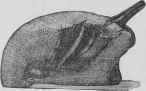
Fig. no.

Fig 111.
Continue to:


My Books

