


(2526). Recipes For Miscellaneous Cold Hatelets, Bellevue Vegetables; Croutons, Chopped Transparent Jelly And Sticky Chopped Jelly (Hatelets Froids Divers En Bellevue, De Legumes; De Croutons Et Gelee Hachee Transparente Et De Gelee Hachee Collante)
Description
This section is from the book "The Epicurean", by Charles Ranhofer. Also available from Amazon: The Epicurean, a Complete Treatise of Analytical and Practical Studies on the Culinary Art.
(2526). Recipes For Miscellaneous Cold Hatelets, Bellevue Vegetables; Croutons, Chopped Transparent Jelly And Sticky Chopped Jelly (Hatelets Froids Divers En Bellevue, De Legumes; De Croutons Et Gelee Hachee Transparente Et De Gelee Hachee Collante)
Cold hatelets are to be prepared with plain or double white cocks'-combs enveloped in jelly, and round, black, unpeeled truffles glazed over with meat glaze (No. 402). Others are made of trussed crawfish from which the small legs have been suppressed and the body shells rubbed over with a little oil, channeled mushrooms (No. 118) coated with jelly, chicken or game quenelles (No. 91), decorated and molded in Bellevue or simply covered, or else carved vegetables blanched separately. These hatelets can also be composed of crawfish, lemons, truffles and mushrooms, having one small glazed truffle on top, a lightly oiled trussed crawfish under this truffle, and then a fine channeled glazed mushroom, having the upper part rounded, then a lemon cut into points; first one-half of the lemon, placed with the points upward, then a round piece of truffle and the other half of the lemon, the points downward, and finished with a glazed channeled mushroom, having the rounded end toward the bottom.
Lean Hatelets for Fish are composed of shrimps, crawfish, truffles, mushrooms or lemon. Cocks'-combs are not admissible for this kind of hatelets.
Bellevue Hatelets
Prepare these hatelets as follows: Cut out with a tin tube three-fourths of an inch in diameter and an eighth of an inch in thickness, small rounds of chicken, cooked beef tongue and truffles; take pieces from the center with a smaller tin tube one-eighth of an inch in diameter; run a hatelet through six of these rounds, beginning first by putting a small round whole truffle, then a round of chicken, tongue and truffle; begin again with another round of chicken, tongue and truffle, leaving a space between each. Cut off the upper crust of a loaf of bread, this to be six inches high; spread over the top to replace the crust a layer of butter a quarter of an inch thick; on top place the hatelet eases or molds (Fig. 501); run through the metal hatelets decorated with the rounds exactly in the center, stand them upright, then fill the molds with cold jelly (No. 103) and keep them in a cool place for several hours. When ready to serve the pieces unmold these hatelets and run a fine unpeeled, round and black truffle on each one, then stick them into the piece.
Carrots and turnips can be substituted for the chicken and tongue.
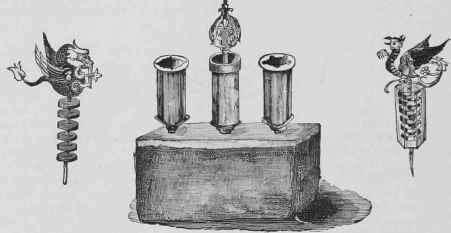
Fig. 501.
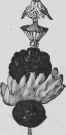
Fig. 502.
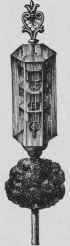
Fig. 503.
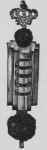
Fig. 504.
Vegetable Hatelets
These hatelets are composed of vegetables or roots, imitating rases of various kinds: they are turned and carved with a knife, and formed of several pieces, then filled with artificial (lowers made of vegetables, such as roses, camelias. lilies, or daisies; these flowers are colored by dipping them in a solution of aniline dissolved in alcohol and diluted with water. If these flowers are well made they can imitate the natural ones most marvelously. They can be used plain, without any coloring, but this is a matter of taste cold service;.
For Chopped Transparent Jelly the fragments of jelly croutons are generally used, chopping them on a moistened cloth with a large knife; they should be chopped sufficiently fine, still not allowing them to get thick looking; they may also be cut into small fine lengthwise strips, afterward cutting them across in small squares; in this way they are sure to remain transparent.
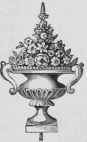
Fig. 505.
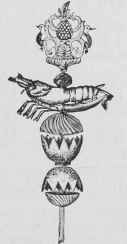
Fig. 506.
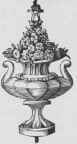
Fig. .507.
Sticky Chopped Jelly is used for pushing through a pocket or paper cornet around a cold meat piece, and is also frequently used to cover the surface of a high foundation that is to be used as a support. In order to obtain a sticky jelly, chop it up on a wet cloth, and sprinkle it over from time to time with some hot water, until it forms into a soft compact mass. This must be used at once.
Continue to:


My Books

