


(3618). Recipes For Flowers Of Pulled Sugar (Fleurs En Sucre Tire)
Description
This section is from the book "The Epicurean", by Charles Ranhofer. Also available from Amazon: The Epicurean, a Complete Treatise of Analytical and Practical Studies on the Culinary Art.
(3618). Recipes For Flowers Of Pulled Sugar (Fleurs En Sucre Tire)
Among the various objects that can be made of pulled sugar must be mentioned flowers and all kinds of leaves, which with a little taste and skill can be beautifully imitated, and if this branch of decoration is studied it can become one of artistic merit. At the beginning learners should not undertake the task of making difficult flowers, such as roses, dahlias, or other flowers having numerous petals, but must be satisfied with more simple ones, such as apple blossoms, wild roses, poppies, pansies, etc

Fig. 735.
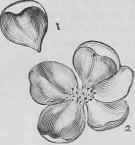
Fig. 736.
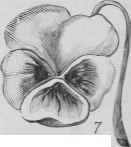
Fig. 737.
Cook the sugar to "large crack" (No. 171), or 335 degrees Fahrenheit, being careful to have it very clear, transparent and grainless. Let it get cold on a marble slab. Melt a pound of this sugar in a copper pan, keeping it as white as possible. Pour a tablespoonful of the syrup on the marble, and add to it the coloring matter for the intended flowers; pound the color should it be dry; then pour over the melted sugar, and work the whole together with a spatula, and afterward with the hand until it becomes smooth and tractable. Put this pulled sugar into a mold, or on a lightly oiled dish, and then in a heater which should register 170 degrees Fahrenheit.
It will be enough for us to explain the making of just a few kinds of flowers, in order that the work fur all others may be understood. For instance, we will begin with a cluster of apple blossoms: Take from the heater a small quantity of very white pulled sugar, and dipping the finger in corn starch to prevent them sticking to the sugar make some petals as shown in Fig. 735, pressing it down between the thumb and first finger as thinly as possible, and detaching it with a pair of scissors as fast and as soon as it is pressed into shape, varying the shapes so that when finished they are not all alike.
Use the flame of a small gas to keep the sugar soft; now heat the bottom of each petal over this gas flame, and adjust live of them togther to form each separate Bower (Fig. 736). Make also buds and partly opened flowers. Color a little gum paste a bright yellow with a small wooden or bone tool, and form the inside. Paint the edges of the petals a pale pink, also the buds, being careful to use the coloring matter as dry as possible. Now color a little of the pulled sugar green and form the leaves the same way as the flowers, afterward pressing them on a lightly oiled plaster mold to mark the veins (Fig. 740, No. 3). Melt all the fragments of the various colored pulled sugars, and add to it some cocoa, and with it coat various lengths of wire; twist them to resemble brauches of trees, and stick them together (Fig. 740, No. 4), and on it mount the flowers and buds (Fig. 741). Proceed exactly the same for all petal flowers, such as leaves, roses, violets, tulips, poppies and pansies (see Fig. 737, No. 7, for the pansies).
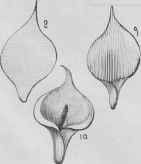
Fig. 738.
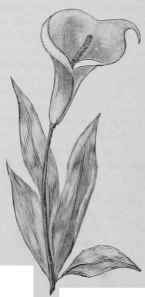
Fig. 739.
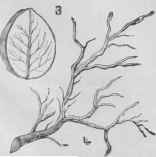
Fig. 740.
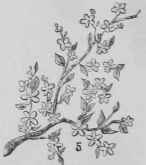
Fig. 741.
The bunch of apple blossoms, if well made, is most natural. For calla lilies the operation is entirely different. Leave the sugar, pulled very white, in the heater until it runs slightly. The principal object is to work it quickly. Take a small piece from the heater, the size of a walnut, and roll it with the rolling-pin on marble as thinly as possible, always using corn starch for the roller and fingers. Cut the sugar rapidly with the scissors into pieces the shape of leaves, having the bottom part pulled out lengthways; heating these over the gas, should the sugar get too cold (Fig. 738, No. 8), bend them into cornets (Fig. 738, No. 9), always while heating, and fold the edges outward (Fig. 738, No. 10). Color a little sugar a bright yellow, and make the inside of the flower. Coat it lightly with gum arabic, and roll it in powdered sugar that has already been tinted to a fine yellow.
Leaves are made the same way; roll them out with the roller, cut them into long shapes, and press on a plaster mold to mark the veins.
Mount the flowers and leaves on stalks of wire covered with green sugar (Fig. 739).
The principal thing to be observed when making any object, either of sugar or nougat, is to perforin the work as speedily as possible, for the less the pulled sugar is heated at the gas flame the more beautiful and brilliant it, will remain, and its glossy luster will not be marred.
Satinated Pulled Sugar
Place three and a, half pounds of lump sugar in an untinned copper pan and moistening with one quart of lukewarm water, leave soak for a few moments. Cook it on a brisk fire, skim and wash the same as for caramel and after a few boils add a heaping coffeespoonful of cream of tartar. Let the sugar attain three hundred degrees, then pour it on to a very cold, slightly oiled marble. When sufficiently cold to allow it to be handled mass it all together and pull it slowly, then mass again with the palm of the hand; pull it again a little, just sufficient to give it a clouded appearance. Put it in the heater and use small quantities, according to the work to be done, pulling and massing to give it a brilliant surface. Never use this sugar when too hot, on the contrary work it as cold as possible so that it will not lose its brilliancy. Flowers, leaves, baskets, etc., can be made with satinated sugar.
Continue to:


My Books

